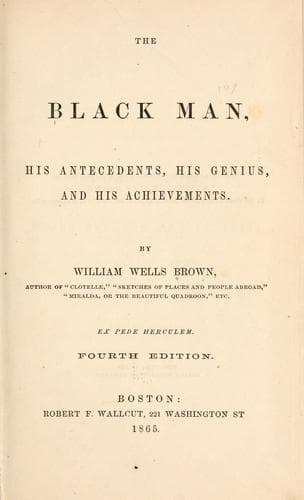
The Black Man: His Antecedents, His Genius, and His AchievementsBrown, William Wells
History
The Black Man: His Antecedents, His Genius, and His Achievements
Brown, William Wells
African Americans -- Biography
"Freedom and liberty are not synonyms. Freedom is an essence;
liberty, an accident. Freedom is born within man; liberty
may be conferred on him. Freedom is progressive; liberty is
circumscribed. Freedom is the gift of God; liberty, the creature
of society. Liberty may be taken away from man; but on whatsoever
soul freedom may alight, the course of that soul is thenceforth
onward and upward; society, customs, laws, armies, are but as
withes in its giant grasp, if they oppose--instruments to work its
will, if they assent. Human kind welcome the birth of a free soul
with reverence and shoutings, rejoicing in the advent of a fresh
offshoot of the divine whole, of which this is but a part."
His article in the _Anglo-African Magazine_, on "Citizenship," is one
of the most logical arguments ever written in this country upon that
subject. In the same journal, Dr. Smith has an essay on "The Fourteenth
Query of Thomas Jefferson's Notes on Virginia," not surpassed by any
thing which we have seen. These are the result of choice study, of nice
observation, of fine feeling, of exquisite fancy, of consummate art,
and the graceful tact of the scholar. Space will not allow us to select
the many choice bits that we could cull from the writings of James
M'Cune Smith.
The law of labor is equally binding on genius and mediocrity. The
mind and body rarely visit this earth of ours so exactly fitted to
each other, and so perfectly harmonizing together, as to rise without
effort, and command in the affairs of men. It is not in the power
of every one to become great. No great approximation, even toward
that which is easiest attained, can ever be accomplished without the
exercise of much thought and vigor of action; and thus is demonstrated
the supremacy of that law which gives excellence only when earned, and
assigns to labor its unfailing reward.
It is this energy of character, industry, and labor, combined with
great intellectual powers, which has given Dr. Smith so much influence
in New York. As a speaker, he is eloquent, and, at times, brilliant,
but always clear and to the point. In stature, the doctor is not
tall, but thick, and somewhat inclined to corpulency. He has a fine
and well-developed head, broad and lofty brow, round, full face, firm
mouth, and an eye that dazzles. In blood, he appears to be rather more
Anglo-Saxon than African.
BISHOP PAYNE.
Teacher of a small school at Charleston, South Carolina, in the year
1834, Daniel A. Payne felt the oppressive hand of slavery too severely
upon him, and he quitted the southern Sodom and came north. After going
through a regular course of theological studies at Gettysburg Seminary,
he took up his residence at Baltimore, where he soon distinguished
himself as a preacher in the African Methodist denomination. He was
several years since elected bishop, and is now located in the State of
Ohio.
Public-domain text, read in full here on John Shaqi.
Reviews
Reviews
No reviews yet
Be the first to share your thoughts on this work.
Elsewhere in the archive
Join the Discussion
Join the discussion
Sign in to leave a comment or review.
Sign InorCreate an account