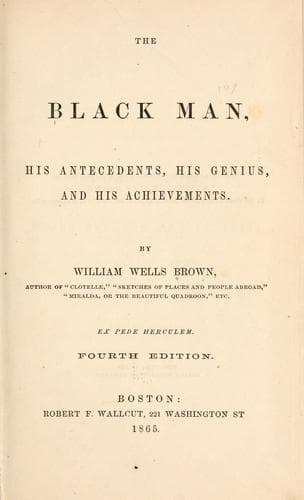
The Black Man: His Antecedents, His Genius, and His AchievementsBrown, William Wells
History
The Black Man: His Antecedents, His Genius, and His Achievements
Brown, William Wells
African Americans -- Biography
The long connection of Mr. Still with the anti-slavery office, in a
city through which fugitive slaves had to pass in their flight from
bondage, and the deep interest felt by him for the freedom and general
welfare of his race, have brought him prominently before the public.
It would not be good policy to say how many persons passed through
his hands while on their way to the north or the British dominions,
even if we knew. But it is safe to say that no man has been truer
to the fleeing slave than he. In the first town where I stopped in
Canada, while on a visit there a year since, I took a walk through the
market one Saturday morning, and saw a large sprinkling of men and
women who had escaped from the south. As soon as it was understood
that I was from "the States," I was surrounded and overwhelmed with
inquiries about places and persons. A short, stout, full-faced,
energetically-talking woman, looking me fairly in the eyes, said, "Were
you ever in Philadelphia, sonny?" I answered that I had been there.
"Did you know Mr. Still?" "Yes," said I: "do you know him?" "God love
your heart! I reckon I does. He put me fru dat city on a swingin' limb,
dat he did. Ah! he's a man dat can be depended on." This was only the
opening; for as soon as it was known that I was well acquainted with
William Still, the conversation turned entirely upon him, and I was
surprised to see so many before me whom he had assisted. And though
there were some present who complained of other Underground Railroad
conductors, not a single word was uttered against Mr. Still; but all
united in the strongest praise of him. In every town that I visited
during a stay of ten weeks in Canada, I met persons who made feeling
inquiries after him, and I was glad to find that all regarded him as
a benefactor. Mr. Still is well educated, has good talents, and has
cultivated them. He is an interesting and forcible writer, and some of
the stories of escaped slaves, which he has contributed to the press,
will challenge criticism. A correspondent of one of the public journals
sent the following account to his paper of an interview which he had
with Mr. Still the day previous:--
"We sat down to talk. The ultimate destiny of the black man was
discussed, our host opening that his struggle for a habitation and a
name must be in America. He said that his people were attached to the
republic, notwithstanding many disadvantages imposed upon them, their
hope being strong that patience and good citizenship would eventually
soften the prejudices of the whites. Tempered as they were to our
habits and climate, it would be cruel to place them on a strand but
dimly known, where, surrounded by savages, they might become savage
themselves.
Public-domain text, read in full here on John Shaqi.
Reviews
Reviews
No reviews yet
Be the first to share your thoughts on this work.
Elsewhere in the archive
Join the Discussion
Join the discussion
Sign in to leave a comment or review.
Sign InorCreate an account