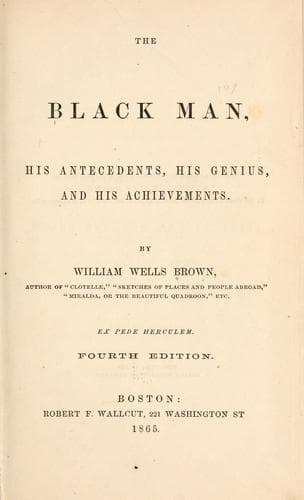
The Black Man: His Antecedents, His Genius, and His AchievementsBrown, William Wells
History
The Black Man: His Antecedents, His Genius, and His Achievements
Brown, William Wells
African Americans -- Biography
Fabre Geffrard, born at Cayes, in the year 1806, was the son of a
general who had shown himself humane under Dessalines, and had been
with Petion, one of the chief promoters of the constitution of 1806.
Left early an orphan, young Geffrard entered the army at the age
of fifteen, and only after twenty-two years' service obtained his
captain's commission. He took part--unwisely, as events proved--in the
revolution of 1843, which overturned the able but indolent Boyer, and
distinguished himself at the head of a small body of troops against the
government forces, deceiving them as to his numbers by the rapidity
of his movements, and as to his resources by supplying provisions to
his famished enemies at a time when he himself was short of rations.
When the revolution, which had originated with the most impatient of
the mulattoes, led in turn to a rising of that portion of the blacks
who represented absolute barbarism, and whose axiom was that every
mulatto should be exterminated, Geffrard marched against and defeated
the black leader, Arcaau; but, true to that humanity which seems
the very basis of his character, we find him in turn defending the
middle classes from the blacks, and the insurgent blacks, when taken
prisoners, from the National Guard. He became lieutenant-general during
these movements; but General Riche, who was made president in 1846, and
who bore Geffrard a grudge for having on a former occasion made him
a prisoner, sent him before a court martial, which, in Hayti, means
sending one to death. Through the adroitness, however, of Riche's
minister of war, the general was acquitted. The president of the court
martial was Soulouque, who seems to have imbibed, on this occasion,
a strange friendship for the man whose life he had been the means of
preserving, and who thus spared him, in an otherwise unaccountable
manner, during his subsequent rule, and even forced on him the title
of duke, which Geffrard did not care to assume. In two disastrous
wars which he undertook, in 1849 and in 1855-6, against the Dominican
republic, Geffrard alone won credit. In the former he was wounded at
the head of the division; in both, by his courage, his activity, his
cheerfulness, and above all, by his anxious care for the welfare of
his soldiers, he exhibited the most striking contrast to Soulouque's
imbecile generalship and brutal indifference to the safety of others.
Public-domain text, read in full here on John Shaqi.
Reviews
Reviews
No reviews yet
Be the first to share your thoughts on this work.
Elsewhere in the archive
Join the Discussion
Join the discussion
Sign in to leave a comment or review.
Sign InorCreate an account