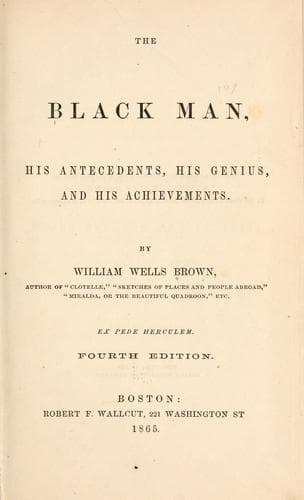
The Black Man: His Antecedents, His Genius, and His AchievementsBrown, William Wells
History
The Black Man: His Antecedents, His Genius, and His Achievements
Brown, William Wells
African Americans -- Biography
"It would be a source of continual pleasure could we have in some
public room pictures true to life of those intrepid heroes, Denmark
Veazie and Nat Turner, whose very names were a terror to oppressors;
who, conceiving the sublime idea of freedom for themselves and their
race, animated by a love of liberty of which they had been ruthlessly
deprived, made an attempt to sever their bonds; and though, in such
attempts to open the prison doors of slavery and let the oppressed go
free, they were unsuccessful, their efforts and determination were
none the less noble and heroic. In the future history of our country,
their names to us will shine as brightly as that of the glorious old
hero, who, with his colored and white followers, so strategically
captured Harper's Ferry, and touched a chord in the life of our country
that will vibrate throughout the land, and will not cease until the
last fetter has been struck from the limbs of the last bondman in the
nation; and though the bodies of these heroes lie mouldering in the
clay, their souls are 'marching on.'
"I never visit our 'Cradle of Liberty,' and look at the portraits
that grace its walls, without thinking that the selection is sadly
incomplete, because the picture of the massacred Crispus Attucks is
not there. He was the first martyr in the Boston massacre of March 5,
1770, when the British soldiers were drawn up in line on King (now
State) Street, to intimidate the Boston populace. On that eventful day,
a band of patriots, led by Attucks, marched from Dock Square to drive
the redcoats from the vicinity of the old State House. Emboldened by
the courageous conduct of this colored hero, the band pressed forward,
and in attempting to wrest a musket from one of the British soldiers,
Attucks was shot. His was the first blood that crimsoned the pavement
of King Street, and by the sacrifice of his life, he awoke that fiery
hatred of British oppression which culminated in the declaration of
American independence. At this late day a portrait of this hero cannot
be had; but our children will live to see the day when the people of
this commonwealth, mindful of their deep and lasting obligation, will,
through their legislature, appropriate a sufficient sum wherewith to
erect a suitable monument to preserve the memory of Attucks, and mark
the spot where he fell."
Mr. Morris deserves great credit for having fought his way up to his
present position. Rumor says that his profession has paid him well,
and that he is now a man of property. If so, we are glad; for the poet
writes, "If thou wouldst have influence, put money in thy purse."
WILLIAM J. WILSON.
Public-domain text, read in full here on John Shaqi.
Reviews
Reviews
No reviews yet
Be the first to share your thoughts on this work.
Elsewhere in the archive
Join the Discussion
Join the discussion
Sign in to leave a comment or review.
Sign InorCreate an account