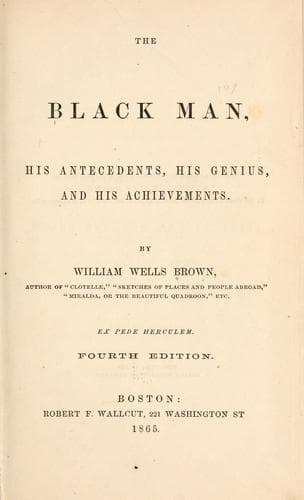
The Black Man: His Antecedents, His Genius, and His AchievementsBrown, William Wells
History
The Black Man: His Antecedents, His Genius, and His Achievements
Brown, William Wells
African Americans -- Biography
"Sir, this is our country as much as it is yours, _and we will not
leave it_. Your ships may be at the door, but we choose to remain.
A few may go, as a few went to Hayti, and a few to Liberia; but the
colored people as a mass will not leave the land of their birth. Of
course, I can only speak by authority for myself; but I know the people
with whom I am identified, and I feel confident that I only express
their sentiment as a body when I say that your project of colonizing
them in Central America, or any where else, with or without their
consent, will never succeed. They will migrate, as do other people,
when left to themselves, and when the motive is sufficient; but they
will neither be 'compelled to volunteer,' nor _constrained_ to go of
their 'own accord.'"
JOSEPH JENKINS.
"Look here, upon this picture, and on this."--HAMLET.
No one accustomed to pass through Cheapside could fail to have noticed
a good-looking man, neither black nor white, engaged in distributing
bills to the thousands who throng that part of the city of London.
While strolling through Cheapside, one morning, I saw, for the fiftieth
time, Joseph Jenkins, the subject of this article, handing out his
bills to all who would take them as he thrust them into their hands.
I confess that I was not a little amused, and stood for some moments
watching and admiring his energy in distributing his papers. A few days
after, I saw the same individual in Chelsea, sweeping a crossing; here,
too, he was equally as energetic as when I met him in the city. Some
days later, while going through Kensington, I heard rather a sweet,
musical voice singing a familiar psalm, and on looking round was not
a little surprised to find that it was the Cheapside bill-distributor
and Chelsea crossing-sweeper. He was now singing hymns, and selling
religious tracts. I am fond of patronizing genius, and therefore took
one of his tracts and paid him for a dozen.
Public-domain text, read in full here on John Shaqi.
Reviews
Reviews
No reviews yet
Be the first to share your thoughts on this work.
Elsewhere in the archive
Join the Discussion
Join the discussion
Sign in to leave a comment or review.
Sign InorCreate an account