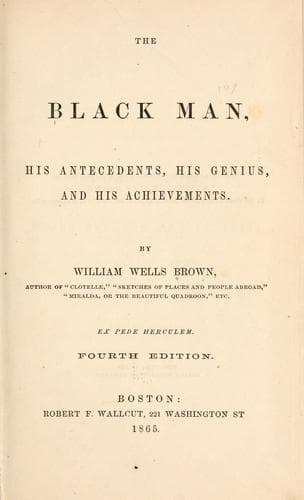
The Black Man: His Antecedents, His Genius, and His AchievementsBrown, William Wells
History
The Black Man: His Antecedents, His Genius, and His Achievements
Brown, William Wells
African Americans -- Biography
In 1853, Dr. Rock came to Boston, where he now resides. On leaving the
city of Philadelphia, the professors of the Dental College gave him
letters bearing testimony to his high professional skill and integrity.
Professor Townsend writes, "Dr. Rock is a graduate of a medical
school in this city, and is favorably known, and much respected, by
the profession. Having seen him operate, it gives me great pleasure
to bear my testimony to his superior abilities." Professor J. F. B.
Flagg writes, "I have seen his operations, and have been much pleased
with them. As a scientific man, I shall miss the intercourse which I
have so long enjoyed in his acquaintance." After Mr. R. graduated in
medicine, he practised both of his professions. In 1856, he accepted
an invitation to deliver a lecture on the "Unity of the Human Races,"
before the Massachusetts legislature. In 1857, he delivered the
oration on the occasion of the dedication of the new Masonic Temple in
Eleventh Street, Philadelphia. His intense application to study and
to business had so undermined his health that, in the summer of 1856,
he was obliged to give up all business. After several unsuccessful
surgical operations here, and when nearly all hope for the restoration
of his health was gone, he determined to go to France. When he was
ready to go, he applied to the government for a passport. This was
refused, Mr. Cass, then secretary of state, saying in reply, that "a
passport had never been granted to a colored man since the foundation
of the government." Mr. Rock went to France, however, and underwent
a severe surgical operation at the hands of the celebrated Nélaton.
Professor Nélaton advised him to give up dentistry altogether; and
as his shattered constitution forbade the exposure necessary for the
practice of medicine, he gave up both, and bent all his energies to
the study of law. In 1860, he accepted an invitation, and delivered
a lecture on the "Character and Writings of Madame De Staël," before
the Massachusetts legislature, which he did "with credit to himself
and satisfaction to the very large audience in attendance." _Der
Pionier_, a German newspaper, in Boston, said, when commenting on his
criticism of De Staël's "Germany," "This thinking, educated German and
French speaking negro proved himself as learned in German as he is in
French literature." On the 14th of September, 1861, on motion of T.
K. Lothrop, Esq., Dr. Rock was examined in the Superior Court, before
Judge Russell, and admitted to practice as an attorney and counsellor
at law in all the courts of Massachusetts. On the 21st of the same
month Mr. Rock received a commission from the governor and council as a
justice of the peace for seven years for the city of Boston and county
of Suffolk.
We annex an extract from a speech made by him before the last
anniversary of the Massachusetts Anti-Slavery Society.
Public-domain text, read in full here on John Shaqi.
Reviews
Reviews
No reviews yet
Be the first to share your thoughts on this work.
Elsewhere in the archive
Join the Discussion
Join the discussion
Sign in to leave a comment or review.
Sign InorCreate an account