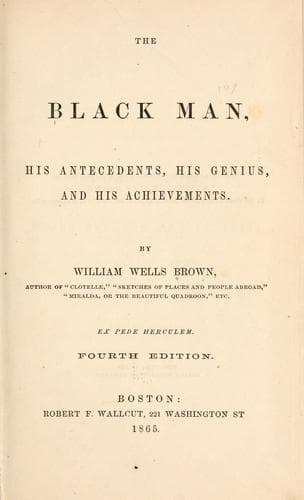
The Black Man: His Antecedents, His Genius, and His AchievementsBrown, William Wells
History
The Black Man: His Antecedents, His Genius, and His Achievements
Brown, William Wells
African Americans -- Biography
Among the colored troops which Major-General Butler found at New
Orleans, when that place was evacuated by the rebels, was the Second
Louisiana Native Guards. When General Banks superseded General Butler,
and took command, the Second Louisiana was stationed at Baton Rouge.
This was considered one of the finest regiments in that section. The
line officers were all colored, and the best discipline prevailed
throughout the ranks. Nevertheless, the white officers of the New
England troops, either through jealousy, or hatred to the colored men
on account of their complexion, demanded that the latter should be
turned out of office, and that their places be filled by whites, from
the ranks of the other regiments. And to the everlasting shame of
General Banks, and the disgrace of the Union cause, the gallant men who
had got up the Second Louisiana regiment were dismissed. The order for
this change had scarcely been promulgated ere the retiring officers
found themselves the object of so much obloquy and abuse that they
were forced to quit Baton Rouge and return to New Orleans. The colored
soldiers were deeply pained at seeing the officers of their choice
taken from them, for they were much attached to their commanders,
some of whom were special favorites with the whole regiment. Among
these were First Lieutenant Joseph Howard, of Company I, and Second
Lieutenant Joseph G. Parker, of Company C. These gentlemen were both
possessed of ample wealth, and had entered the army, not as a matter of
speculation, as too many have done, but from a love of military life.
Their hatred of oppression, and attachment to the Union cause, kept
them from following the rebels in their hasty flight.
Lieutenant Howard was a man of more than ordinary ability in military
tactics, and a braver or more daring officer could not be found in the
valley of the Mississippi. He was well educated, speaking the English,
French, and Spanish languages fluently, and was considered a scholar
of rare literary attainments. He, with his friend, felt sorely the
deep humiliation attending their dismissal, and they seldom showed
themselves on the streets of their native city.
Public-domain text, read in full here on John Shaqi.
Reviews
Reviews
No reviews yet
Be the first to share your thoughts on this work.
Elsewhere in the archive
Join the Discussion
Join the discussion
Sign in to leave a comment or review.
Sign InorCreate an account