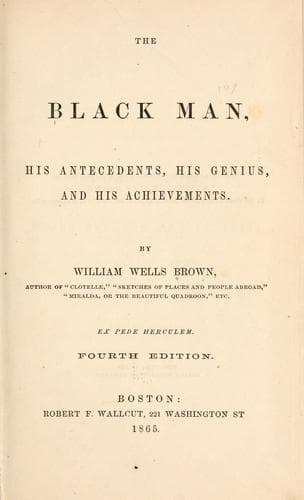
The Black Man: His Antecedents, His Genius, and His AchievementsBrown, William Wells
History
The Black Man: His Antecedents, His Genius, and His Achievements
Brown, William Wells
African Americans -- Biography
His first attempt to escape was made when he was about ten years of
age, and from that time to 1840 his life was a constant series of
flights and recaptures, the narrative of which makes one thrill and
shudder at the sufferings endured and the barbarities inflicted.
Securing his freedom by his own good legs, Henry Bibb at once began
seeking an education; and in this he succeeded far beyond many white
men who have had all the avenues to learning open to them. In personal
appearance he was tall and slim, a pleasing countenance, half white,
hair brown, eyes gray, and possessed a musical voice, and a wonderful
power of delivery. No one who heard Mr. Bibb, in the years 1847,
'8, and '9, can forget the deep impression that he left behind him.
His natural eloquence and his songs enchained an audience as long
as the speaker wanted them. In 1849, we believe, he went to Canada,
and started a weekly paper called _The Voice of the Fugitives_, at
Windsor. His journal was well conducted, and was long regarded as
indispensable in every fugitive's house. His first wife being left in
slavery, and no hope of her escaping, Mr. Bibb married for his second
wife the well-educated and highly-cultivated Mary E. Miles, of Boston.
After being in Canada a while, the two opened a school for their
escaped brothers and sisters, which proved a lasting benefit to that
much-injured class. His efforts to purchase a tract of land, and to
deal it out in lots to the fugitives at a reasonable price, was only
one of the many kind acts of this good man. There are few characters
more worthy of the student's study and imitation than that of Henry
Bibb. From an ignorant slave, he became an educated free man, by his
own powers, and left a name that will not soon fade away.
In one of Cassimir de la Vigne's dramas, we met with an expression
which struck us forcibly. It was said of Don John, who was ignorant of
his birth, that perhaps he was a nobody; to which he replied, "That a
man of good character and honorable conduct could never be a nobody."
We consider this an admirable reply, and have endeavored to prove this
truth by the foregoing example. If it is gratifying and noble to bear
with honor the name of one's father, it is surely more noble to make
a name for one's self; and our heart tells us that among our young
readers there is more than one who will exclaim with ardor, and with a
firm resolution to fulfil his promise, _I, too, shall make a name_.
PLACIDO.
Public-domain text, read in full here on John Shaqi.
Reviews
Reviews
No reviews yet
Be the first to share your thoughts on this work.
Elsewhere in the archive
Join the Discussion
Join the discussion
Sign in to leave a comment or review.
Sign InorCreate an account