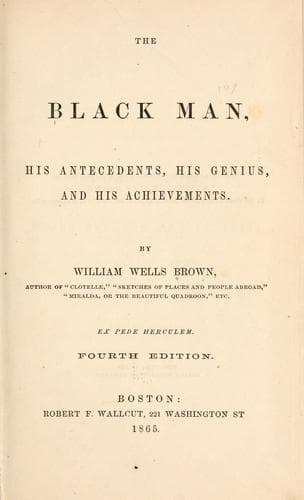
The Black Man: His Antecedents, His Genius, and His AchievementsBrown, William Wells
History
The Black Man: His Antecedents, His Genius, and His Achievements
Brown, William Wells
African Americans -- Biography
In the year 1830, there was a young man in Havana, son of a woman
who had been brought, when a child, from the coast of Africa, and
sold as a slave. Being with a comparatively kind master, he soon
found opportunity to begin developing the genius which at a later
period showed itself. The young slave was called Placido. He took an
especial interest in poetry, and often wrote poems that were set to
music and sung in the drawing rooms of the most refined companies
which assembled in the city. His young master paying his addresses to
a rich heiress, the slave was requested to write a poem embodying the
master's passion for the young lady. Placido acquitted himself to the
entire satisfaction of the lover, who copied the epistle in his own
hand, and sent it on its mission. The slave's compositions were so much
admired that they found their way into the newspaper; but no one knew
the negro as the author. In 1838, these poems, together with a number
which had never appeared in print, were intrusted to a white man, who
sent them to England, where they were published and much praised for
the talent and scholarly attainment which they developed. A number of
young whites, who were well acquainted with Placido and his genius,
resolved to purchase him and present him his freedom, which they did in
the year 1842. But a new field had opened itself to the freed black,
and he began to tread in its paths. Freedom for himself was only the
beginning; he sighed to make others free. The imaginative brain of
the poet produced verses which the slaves sung in their own rude way,
and which kindled in their hearts a more intense desire for liberty.
Placido planned an insurrection of the slaves, in which he was to be
their leader and deliverer; but the scheme failed. After a hasty trial,
he was convicted and sentenced to death. The fatal day came; he walked
to the place of execution with as much calmness as if it had been to an
ordinary resort of pleasure. His manly and heroic bearing excited the
sympathy and admiration of all who saw him. As he arrived at the fatal
spot he began reciting the following hymn, which he had written in his
cell the previous night:--
TO GOD--A PRAYER.
"Almighty God! whose goodness knows no bound,
To thee I flee in my severe distress;
O let thy potent arm my wrongs redress,
And rend the odious veil by slander wound
About my brow. The base world's arm confound,
Who on my front would now the seal of shame impress.
God of my sires, to whom all kings must yield,
Be thou alone my shield; protect me now:
All power is His, to whom the sea doth owe
His countless stores; who clothed with light heaven's field,
And made the sun, and air, and polar seas congealed;
All plants with life endowed, and made the rivers flow.
Public-domain text, read in full here on John Shaqi.
Reviews
Reviews
No reviews yet
Be the first to share your thoughts on this work.
Elsewhere in the archive
Join the Discussion
Join the discussion
Sign in to leave a comment or review.
Sign InorCreate an account