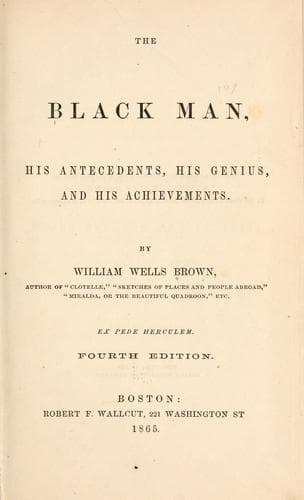
The Black Man: His Antecedents, His Genius, and His AchievementsBrown, William Wells
History
The Black Man: His Antecedents, His Genius, and His Achievements
Brown, William Wells
African Americans -- Biography
One of the charges against Dessalines is based upon the fact that
he changed his government from a republic to an empire. But we must
consider that the people of Hayti had always lived under a monarchy,
and were wedded to that kind of government. Had Toussaint allowed
himself to be made a king, his power would have been recognized by
Great Britain, and he would never have yielded to the solicitations of
Leclerc, when that general's fleet landed on the island. Napoleon had
just been crowned emperor of France, and it was not at all surprising
that Dessalines should feel inclined to imitate the conqueror of Egypt.
The empire of Hayti was composed of six military divisions, each to
be under the command of a general officer, who was independent of his
associates who governed in other districts, as he was responsible to
the head of the state alone. The supreme power was formally conferred
upon Jean Jacques Dessalines, the avenger and liberator of his
countrymen, who was to take the title of Emperor and Commander-in-chief
of the Army, and to be addressed by the appellation of His Majesty--a
dignity which was also conferred upon the empress, his wife, and the
persons of both were declared inviolable. The crown was elective, but
the power was conferred upon the reigning emperor to select and appoint
his successor, by a nomination which required the sanction of the
people to give it validity. The emperor was empowered to make the laws
to govern the empire, and to promulgate them under his seal; to appoint
all the functionaries of the state, and remove them at his will; to
hold the purse of the nation; to make peace and war, and in all things
to exercise the rights and privileges of an absolute sovereign. The
monarch was assisted in wielding this mighty authority by a council of
state, composed of generals of division and brigade. No peculiar faith
in religion was established by law, and toleration was extended to the
doctrines and worship of all sects. Surrounded by all the luxuries
that wealth could procure, he was distinguished for the Roman virtues
of abstinence and energy. Scorning effeminacy, he seemed ambitious to
inure himself to the most laborious exercise and to the simplest mode
of living. Dessalines was well schooled in the toils and labors of
the camp. As his life was made up of extremes, so in his habits and
personal endurances were seen great contrasts. Impetuosity and rapid
movement were among his chief characteristics. He prided himself on
his being able to surprise his enemies and taking them unprepared.
Indeed, this was a leading trait in his military character, and places
him alongside of Napoleon, or any other general, ancient or modern. As
time smooths over his footsteps, and wears out the blood that marked
his course, the circumstances attending it will, no doubt, be made
to extenuate some of his many faults, and magnify his virtues as a
general, a ruler, and a man.
Public-domain text, read in full here on John Shaqi.
Reviews
Reviews
No reviews yet
Be the first to share your thoughts on this work.
Elsewhere in the archive
Join the Discussion
Join the discussion
Sign in to leave a comment or review.
Sign InorCreate an account