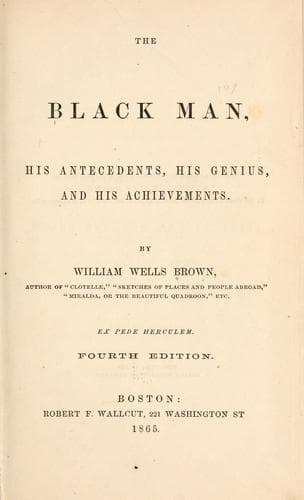
The Black Man: His Antecedents, His Genius, and His AchievementsBrown, William Wells
History
The Black Man: His Antecedents, His Genius, and His Achievements
Brown, William Wells
African Americans -- Biography
two presidents prepared for war, and Christophe opened the campaign
by marching an immense army against Gonaives, which, in the month of
June, 1807, he invested. Petion's troops were defeated, and, to save
themselves from capture, escaped by sea to Port au Prince. The war
continued three years, when a new competitor appeared in the person of
Rigaud, the other mulatto general. Christophe now ceased for a while;
but when he felt that the time had arrived he again renewed the war,
and, in 1810, captured the Mole St. Nicholas, the strongest fort on
the island. Becoming ambitious to be a monarch, Christophe called his
council together, and on the 20th of March, 1811, the session closed by
adopting a new frame of government The imperial constitution of 1805
was modified to form an hereditary monarchy in the north, and to place
the crown of Hayti upon Christophe under the title of Henry the First.
When he entered upon the kingly station that had been conferred upon
him, his first act was to promulgate an edict creating an hereditary
nobility, as a natural support of his government. These dignitaries
of the kingdom were taken mostly from the army, the chiefs who had
fought under him in the struggle against the French, and consisted
of two princes, seven dukes, twenty-two counts, thirty-five barons,
and fourteen chevaliers. His coronation was the most magnificent
display ever witnessed out of Europe. To furnish himself with all the
appointments correspondent to his royal dignity, he now began the
erection of a palace, situated a few miles from the cape, upon which
he had bestowed the historical name of Sans Souci. This palace has
the reputation of being the most splendid edifice in the West Indies.
The rugged, mountainous region in the vicinity of his royal residence
was changed from its original condition to form the gardens of the
palace. Hills were levelled with the plain, deep ravines were filled
up, and roads and passages were opened, leading in all directions
from the royal dwelling. The halls and saloons of the palace were
wrought with mahogany, the floors were laid with rich marble, and
numerous jets-d'eau furnished coolness and a supply of pure water to
the different apartments. Christophe held a levee on the Thursday
evening of each week, which was attended by the most fashionable of all
classes, including the foreign ambassadors and consuls. The ceremonial
observances were modelled after the drawing rooms at St. Cloud and
St. James. Though of pure African blood, Christophe was not a jet
black, his complexion being rather a dusky brown. His person had grown
slightly corpulent, and his address was cold, polished, and graceful.
He possessed a certain air of native dignity that corresponded well
with his high official situation. The whites of all countries, and
especially the English, formed a high opinion of his character. That
part of the island which came within his rule had been well cultivated,
Public-domain text, read in full here on John Shaqi.
Reviews
Reviews
No reviews yet
Be the first to share your thoughts on this work.
Elsewhere in the archive
Join the Discussion
Join the discussion
Sign in to leave a comment or review.
Sign InorCreate an account