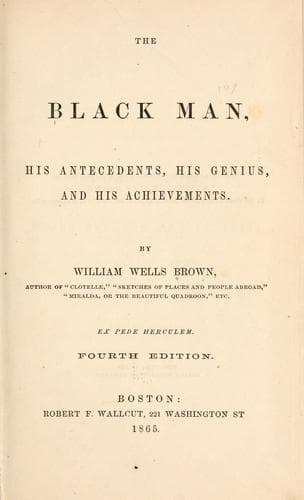
The Black Man: His Antecedents, His Genius, and His AchievementsBrown, William Wells
History
The Black Man: His Antecedents, His Genius, and His Achievements
Brown, William Wells
African Americans -- Biography
that all men were born equal, and that he was surprised that any one
would degrade himself by such conduct,--that he would never cringe
to the whites, nor ought any one who had the feelings of a man. When
answered, 'We are slaves,' he would sarcastically and indignantly
reply, 'You deserve to remain slaves;' and if he were further asked,
'What can we do?' he would remark, 'Go and buy a spelling-book and read
the fable of Hercules and the Wagoner,' which he would then repeat,
and apply it to their situation. He also sought every opportunity
of entering into conversation with white persons, when they could be
overheard by negroes near by, especially in grog shops; during which
conversation, he would artfully introduce some bold remark on slavery;
and sometimes, when, from the character he was conversing with, he
found he might be still bolder, he would go so far, that, had not
his declarations in such situations been clearly proved, they would
scarcely have been credited. He continued this course until some time
after the commencement of the last winter; by which time he had not
only obtained incredible influence amongst persons of color, but many
feared him more than their owners, and, one of them declared, even more
than his God."
The excitement which the revelations of the trial occasioned, and
the continual fanning of the flame by the newspapers, were beyond
description. Double guard in the city, the country patrol on
horseback and on foot, the watchfulness that was observed on all
plantations, showed the deep feeling of fear pervading the hearts of
the slaveholders, not only in South Carolina, but the fever extended
to the other Southern States, and all seemed to feel that a great
crisis had been passed. And indeed, their fears seem not to have been
without ground, for a more complicated plan for an insurrection could
scarcely have been conceived. And many were of opinion that, the rising
once begun, they would have taken the city and held it, and might have
sealed the fate of slavery in the south. The best account of this
whole matter is to be found in an able article in the Atlantic Monthly
for June, 1861, from the pen of that eloquent friend of freedom T. W.
Higginson, and to which I am indebted for the extracts contained in
this memoir of Denmark Vesey.
HENRY HIGHLAND GARNETT.
Public-domain text, read in full here on John Shaqi.
Reviews
Reviews
No reviews yet
Be the first to share your thoughts on this work.
Elsewhere in the archive
Join the Discussion
Join the discussion
Sign in to leave a comment or review.
Sign InorCreate an account