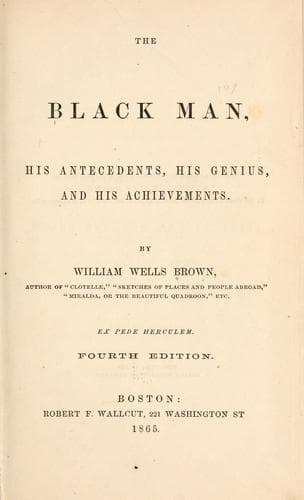
The Black Man: His Antecedents, His Genius, and His AchievementsBrown, William Wells
History
The Black Man: His Antecedents, His Genius, and His Achievements
Brown, William Wells
African Americans -- Biography
him with a pistol in his hand, and, with a loud execration, fired it at
his intended victim. But Rigaud remained unharmed, and, in the scuffle
which ensued, the white assassin was disarmed and put to flight. The
astonishment of the mulattoes soon gave way to tumult and indignation,
and this produced a drawn battle, in which both whites and mulattoes,
exasperated as they were to the utmost, fought man to man. The struggle
continued fiercely until the whites were driven from the town, having
lost one hundred and fifty of their number, and slain many of their
opponents.
Tidings of this conspiracy flew rapidly in all directions; and such was
the indignation of the mulattoes at this attack upon their chief, whose
death had even been announced in several places as certain, that they
seized upon all the whites within their reach; and their immediate
massacre was only prevented by the arrival of intelligence that Rigaud
was still alive. Such were the persecutions which the leader of the
mulattoes, now in exile, had experienced in his own land. Napoleon kept
him confined in the prison of the Temple first, and then at the castle
of Joux, where Toussaint had ended his life.
During this time, St. Domingo was undergoing a great change. Leclerc
had died, Rochambeau and his forces had been driven from the island,
Dessalines had reigned and passed away, and Christophe was master
of the north, and Petion of the south. These two generals were at
war with each other, when they were both very much surprised at the
arrival of Rigaud from France. He had escaped from his prison, made
his way to England, and thence to the island by way of the United
States. Petion, the president of the republic in the south, regarded
Rigaud as a more formidable enemy than Christophe. The great mulatto
general was welcomed with enthusiasm by his old adherents; they showed
the most sincere respect and attachment for him, and he journeyed in
triumph to Port au Prince. Though Petion disliked these demonstrations
in favor of a rival, he dared not attempt to interfere, for he well
knew that a single word from Rigaud could raise a revolt among the
mulattoes. Petion, himself a mulatto, had served under the former in
the first stages of the revolution. The people of Aux Cayes welcomed
their chief to his home, and he drew around him all hearts, and in a
short time Rigaud was in full possession of his ancient power. The
government of Petion was divided to make room for the former chief,
and, though the two leaders for a while flew to arms against each
other, they, nevertheless, were driven to an alliance on account of the
encroachments of Christophe.
After a reign that was fraught only with tumult to himself and
followers, Rigaud abdicated his province, retired to his farm, and in a
few weeks died. Thus ended the career of the most distinguished mulatto
general of which St. Domingo could boast.
FRANCES ELLEN WATKINS.
Public-domain text, read in full here on John Shaqi.
Reviews
Reviews
No reviews yet
Be the first to share your thoughts on this work.
Elsewhere in the archive
Join the Discussion
Join the discussion
Sign in to leave a comment or review.
Sign InorCreate an account