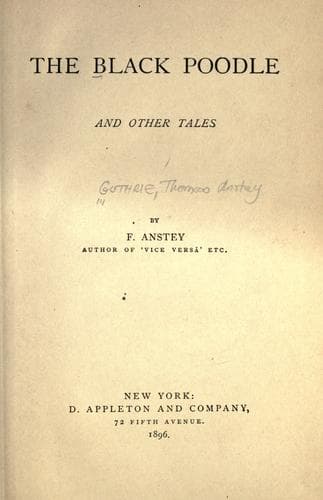
English fiction -- 19th century; Short stories, English
The kitchen door was shut, but the window was not, and, as the sill was
low, he contrived to scramble up somehow and jump into the kitchen,
where he reckoned upon finding friends to protect him.
But he found it empty, and looking strangely cold and desolate; only a
small fire was smouldering in the range, instead of the cheerful blaze
he remembered there, and he could not find the cook--an especial
patroness of his--anywhere.
He scampered up into the hall, making straight for the morning-room,
where he knew he should find Hilda curled up in one of the arm-chairs
with a book.
But that room was empty too--the shutters were up, and the half-light
which streamed in above them showed a dreary state of confusion: the
writing-table was covered with a sheet and put away in a corner, the
chairs were piled up on the centre table, the carpet had been taken up
and rolled under the sideboard, and there was a faint warm smell of flue
and dust and putty in the place.
He pattered out again, feeling puzzled and a little afraid, and went up
the bare stone staircase to find Hilda in one of the upper rooms,
perhaps in the nursery.
But the upper rooms, too, were all bare and sheeted and ghostly, and,
higher up, the stairs were spotted with great stars of whitewash, and
there were ladders and planks on which strange men in dirty white
blouses were talking and joking a great deal, and doing a little
whitewashing now and then, when they had time for it.
Their voices echoed up and down the stairs with a hollow noise that
scared him, and he was afraid to venture any higher. Besides, he knew by
this time somehow that Hilda, her father and mother, all the friends he
had counted upon seeing again, would not be found in any part of that
house.
It was the same house, though stripped and deserted, but all the life
and colour and warmth had gone out of it; and he ran here and there,
seeking for them in vain.
He picked his way forlornly down to the hall again, and there he found a
mouldy old woman with a duster pinned over her head and a dustpan and
brush in her hand; for, unhappily for him, the family, servants and all,
had gone away some days before into the country, and this old woman had
been put into the house as caretaker.
She dropped her brush and pan with a start as she saw him, for she was
not fond of dogs.
'Why, deary me,' she said morosely, 'if it hasn't give me quite a turn.
However did the nasty little beast get in? a-gallivantin' about as if
the 'ole place belonged to him.'
Dandy sat up and begged. In the old days he would not have done such a
thing for any servant below a cook (who was always worth being polite
to), but he felt a very reduced and miserable little animal indeed just
then, and he thought she might be able to take him to Hilda.
But the charwoman's only idea was to get rid of him as quickly as
possible.
'Why, if it ain't a Toby dawg!' she cried, as her dim old eyes caught
sight of his frill. Here, you get out; you don't belong 'ere!'
Public-domain text, read in full here on John Shaqi.
Reviews
Reviews
No reviews yet
Be the first to share your thoughts on this work.
Elsewhere in the archive
Join the Discussion
Join the discussion
Sign in to leave a comment or review.
Sign InorCreate an account