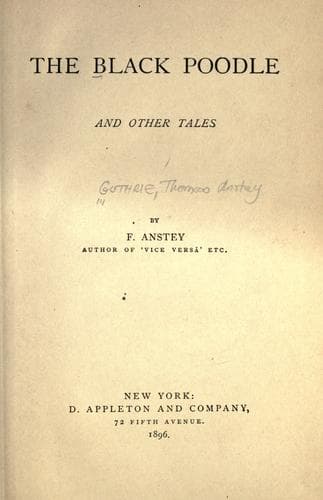
English fiction -- 19th century; Short stories, English
Francis Flushington belonged to a small college, and by becoming a
member conferred upon it one of the few distinctions it could boast--the
possession of the very bashfulest man in the whole university.
But his college did not treat him with any excess of adulation on that
account, and, probably from a prudent fear of rubbing the bloom off his
modesty, allowed him to blush unseen--which was indeed the condition in
which he preferred to blush.
He felt himself distressed in the presence of his fellow men, by a
dearth of ideas and a difficulty in knowing which way to look, that made
him happiest when he had fastened his outer door, and secured himself
from all possibility of intrusion--although this was almost an
unnecessary precaution on his part, for nobody ever thought of coming to
see Flushington.
In appearance he was a man of middle height, with a long neck and a
large head, which gave him the air of being shorter than he really was;
he had little weak eyes which were always blinking, a nose and mouth of
no particular shape, and hair of no definite colour, which he wore
long--not because he thought it becoming, but because he hated having to
talk to his hairdresser.
He had a timid deprecating manner, due to the consciousness that he was
an uninteresting anomaly, and he certainly was as impervious to the
ordinary influences of his surroundings as any modern under-graduate
could well be.
Flushington had never particularly wanted to be sent to Cambridge, and
when he was there he did not enjoy it, and had not the faintest hope of
distinguishing himself in anything; he lived a colourless, aimless sort
of life in his little sloping rooms under the roof where he read every
morning from nine till two with a superstitious regularity, even when
his books failed to convey any ideas whatever to his brain, which was
not a remarkably powerful organ.
If the afternoon was fine, he generally sought out his one friend, who
was a shade less shy than himself, and they went a monosyllabic walk
together (for of course Flushington did not row, or take up athletics in
any form); if it was wet, he read the papers and magazines at the Union,
and in the evenings after hall, he studied 'general literature'--a
graceful periphrasis for novels--or laboriously picked out a sonata or a
nocturne upon his piano, a habit which had not tended to increase his
popularity.
Fortunately for Flushington, he had no gyp, or his life would have been
a burden to him, and with his bedmaker he was rather a favourite, as a
'gentleman what gave no trouble'--which meant that when he observed his
sherry sinking like the water in a lock when the sluices are up, he was
too delicate to refer to the phenomenon in any way.
Public-domain text, read in full here on John Shaqi.
Reviews
Reviews
No reviews yet
Be the first to share your thoughts on this work.
Elsewhere in the archive
Join the Discussion
Join the discussion
Sign in to leave a comment or review.
Sign InorCreate an account