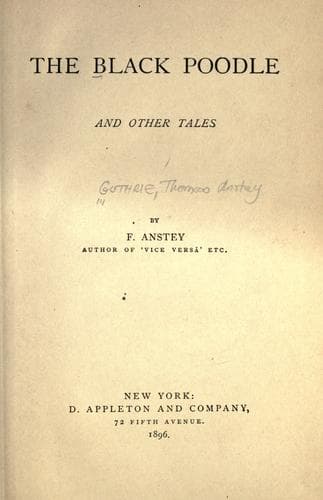
English fiction -- 19th century; Short stories, English
They did put several things in my way--and, as might have been expected,
I came to grief over every one of them, until at length, having given a
fair trial to each opening that had been provided for me, I began to
perceive that my uncle had made a grave mistake in believing me suited
for a colonial career.
I resolved to return home and convince him of his error, and give him
one more opportunity of repairing it; he had failed to discover the best
means of utilising my undoubted ability, yet I would not reproach him
(nor do I reproach him even now), for I too have felt the difficulty.
In pursuance of my resolution, I booked my passage home by one of the
Orient liners from Melbourne to London. About an hour before the ship
was to leave her moorings, I went on board and made my way at once to
the state-room which I was to share with a fellow passenger, whose
acquaintance I then made for the first time.
He was a tall cadaverous young man of about my own age, and my first
view of him was not encouraging, for when I came in, I found him rolling
restlessly on the cabin floor, and uttering hollow groans.
'This will never do,' I said, after I had introduced myself; 'if you're
like this now, my good sir, what will you be when we're fairly out at
sea? You must husband your resources for that. And why trouble to roll?
The ship will do all that for you, if you will only have patience.'
He explained, somewhat brusquely, that he was suffering from mental
agony, not sea-sickness; and by a little pertinacious questioning (for I
would not allow myself to be rebuffed) I was soon in possession of the
secret which was troubling my companion, whose name, as I also learned,
was Augustus McFadden.
It seemed that his parents had emigrated before his birth, and he had
lived all his life in the Colony, where he was contented and fairly
prosperous--when an eccentric old aunt of his over in England happened
to die.
She left McFadden himself nothing, having given by her will the bulk of
her property to the only daughter of a baronet of ancient family, in
whom she took a strong interest. But the will was not without its effect
upon her existence, for it expressly mentioned the desire of the
testatrix that the baronet should receive her nephew Augustus if he
presented himself within a certain time, and should afford him every
facility for proving his fitness for acceptance as a suitor. The
alliance was merely recommended, however, not enjoined, and the gift was
unfettered by any conditions.
Public-domain text, read in full here on John Shaqi.
Reviews
Reviews
No reviews yet
Be the first to share your thoughts on this work.
Elsewhere in the archive
Join the Discussion
Join the discussion
Sign in to leave a comment or review.
Sign InorCreate an account