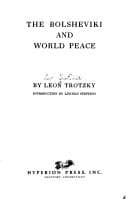
Communism -- Soviet Union; Europe -- Social conditions -- 20th century; Socialism; World War, 1914-1918
At their Convention in Paris two weeks before the outbreak of the
catastrophe, the French Socialists insisted on pledging all branches of
the International to revolutionary action in case of a mobilization.
They were thinking chiefly of the German Social Democracy. The
radicalism of the French Socialists in matters of foreign policy was
rooted not so much in international as national interests. The events of
the War have now definitely confirmed what was clear to many then. What
the French Socialist Party desired from the sister party in Germany was
a certain guarantee for the inviolability of France. They believed that
only by thus insuring themselves with the German proletariat could they
finally free their own hands for a decisive conflict with national
militarism.
The German Social Democracy, for their part, flatly refused to make any
such pledge. Bebel showed that if the Socialist parties signed the
French resolution, that would not necessarily enable them to keep their
pledge when the decisive moment came. Now there is little room for
doubt that Bebel was right. As events have repeatedly proved, a period
of mobilization almost completely cripples the Socialist Party, or at
least precludes the possibility of decisive moves. Once mobilization is
declared, the Social Democracy finds itself face to face with the
concentrated power of the Government, which is supported by a powerful
military apparatus that is ready to crush all obstacles in its path and
has the unqualified co-operation of all bourgeois parties and
institutions.
Public-domain text, read in full here on John Shaqi.
Reviews
Reviews
No reviews yet
Be the first to share your thoughts on this work.
Join the Discussion
Join the discussion
Sign in to leave a comment or review.
Sign InorCreate an account