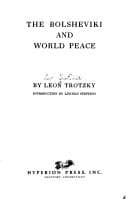
Communism -- Soviet Union; Europe -- Social conditions -- 20th century; Socialism; World War, 1914-1918
And of no less importance is the fact that mobilization wakes up and
brings to their feet those elements of the people whose social
significance is slight and who play little or no political part in times
of peace. Hundreds of thousands, nay millions of petty hand-workers, of
hobo-proletarians (the riff-raff of the workers), of small farmers and
agricultural laborers are drawn into the ranks of the army and put into
a uniform, in which each one of these men stands for just as much as the
class-conscious workingman. They and their families are forcibly torn
from their dull unthinking indifference and given an interest in the
fate of their country. Mobilization and the declaration of war awaken
fresh expectations in these circles whom our agitation practically does
not reach and whom, under ordinary circumstances, it will never enlist.
Confused hopes of a change in present conditions, of a change for the
better, fill the hearts of these masses dragged out of the apathy of
misery and servitude. The same thing happens as at the beginning of a
revolution, but with one all-important difference. A revolution links
these newly aroused elements with the revolutionary class, but war links
them--with the government and the army! In the one case all the
unsatisfied needs, all the accumulated suffering, all the hopes and
longings find their expression in revolutionary enthusiasm; in the other
case these same social emotions temporarily take the form of patriotic
intoxication. Wide circles of the working class, even among those
touched with Socialism, are carried along in the same current. The
advance guard of the Social Democracy feels it is in the minority; its
organizations, in order to complete the organization of the army, are
wrecked. Under such conditions there can be no thought of a
revolutionary move on the part of the Party. And all this is quite
independent of whether the people look upon a particular war with favor
or disfavor. In spite of the colonial character of the Russo-Japanese
war and its unpopularity in Russia, the first half year of it nearly
smothered the revolutionary movement. Consequently it is quite clear
that, with the best intentions in the world, the Socialist parties
cannot pledge themselves to obstructionist action at the time of
mobilization, at a time, that is, when Socialism is more than ever
politically isolated.
Public-domain text, read in full here on John Shaqi.
Reviews
Reviews
No reviews yet
Be the first to share your thoughts on this work.
Elsewhere in the archive
Join the Discussion
Join the discussion
Sign in to leave a comment or review.
Sign InorCreate an account