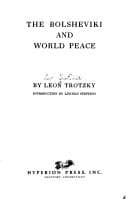
Communism -- Soviet Union; Europe -- Social conditions -- 20th century; Socialism; World War, 1914-1918
The great centralized trade unions of Germany developed in direct
dependence upon the development of national industry, adapting
themselves to its successes in the home and the foreign markets, and
controlling the prices of raw materials and manufactured products.
Localized in political districts to adapt itself to the election laws
and stretching feelers in all cities and rural communities, the Social
Democracy built up the unique structure of the political organization of
the German proletariat with its many-branched bureaucratic hierarchy,
its one million dues-paying members, its four million voters, ninety-one
daily papers and sixty-five Party printing presses. This whole
many-sided activity, of immeasurable historical importance, was
permeated through and through with the spirit of possibilism.
In forty-five years history did not offer the German proletariat a
single opportunity to remove an obstacle by a stormy attack, or to
capture any hostile position in a revolutionary advance. As a result of
the mutual relation of social forces, it was forced to avoid obstacles
or adapt itself to them. In this, Marxism as a theory was a valuable
tool for political guidance, but it could not change the opportunist
character of the class movement, which in essence was at that time alike
in England, France and Germany. For all the undisputed superiority of
the German organization, the tactics of the unions were very much the
same in Berlin and London. Their chief achievement was the system of
tariff treaties. In the political field the difference was much greater
and deeper. While the English proletariat were marching under the banner
of Liberalism, the German workers formed an independent party with a
Socialist platform. Yet this difference does not go nearly as deep in
politics as it does in ideologic forms, and the forms of organization.
Through the pressure that English labor exerted on the Liberal Party it
achieved certain limited political victories, the extension of suffrage,
freedom to unionize, and social legislation. The same was preserved or
improved by the German proletariat through its independent party, which
it was obliged to form because of the speedy capitulation of German
liberalism. And yet this party, while in _principle_ fighting the fight
for political power, was compelled in actual practice to adapt itself to
the ruling power, to protect the labor movement against the blows of
this power, and to achieve a few reforms. In other words: on account of
the difference in historical traditions and political conditions, the
English proletariat adapted itself to the capitalist state through the
medium of the Liberal Party; while the German proletariat was forced to
form a party of its own to achieve the very same political ends. And the
political struggle of the German proletariat in this entire period had
the same opportunist character limited by historical conditions as did
that of the English proletariat.
Public-domain text, read in full here on John Shaqi.
Reviews
Reviews
No reviews yet
Be the first to share your thoughts on this work.
Elsewhere in the archive
Join the Discussion
Join the discussion
Sign in to leave a comment or review.
Sign InorCreate an account