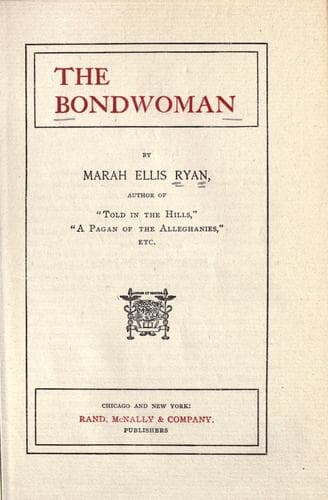
Man-woman relationships -- Fiction; Race relations -- Fiction; United States -- History -- Civil War, 1861-1865 -- Fiction
"But I owe it to myself to offer the proof now," she insisted, "and
at the same time I shall ask Mr. Pierson to offer himself for personal
search if Captain Masterson yet retains suspicion of his honesty;" she
glanced towards Pierson, who smiled slightly, and bowed without
speaking. Then she turned to Delaven, who had been a surprised
onlooker of the scene.
"Dr. Delaven, in the cause of justice, may I ask you to examine the
contents of this letter?" and she tore open the envelope and offered
it.
"Anything in the wide world to serve you, Madame la Marquise," he
answered, with a shade more than usual of deference in his manner, as
he took it. "Are the contents to be considered professionally, that
is, confidentially?"
She had taken Evilena by the hand, bowed slightly to the group, and
had moved to the door, when he spoke. Monroe, who had watched every
movement as he stood there in a fever of suspense for her sake, drew a
breath of relief as she replied:
"Oh, no! Be kind enough to read it aloud, or Captain Masterson may
include you in the dangerous intrigues here," and, smiling still, she
passed out with Evilena to the lawn.
But a few seconds elapsed, when a perfect shout of laughter came from
the library. The special detective did not share in it, for he thrust
his hands into his pockets with a curse, and Masterson turned to him
with a frowning, baffled stare--an absolutely crestfallen manner, as
he listened to the following, read in Delaven's best style:
"To Madame Smith, "Mobile, Ala.:
"The pink morning gown is perfect, but I am in despair over the
night robes! I meant you to use the lace, not the embroidery, on
them; pray change them at once, and send at the same time the
flounced lawn petticoats if completed. I await reply.
"Judithe de Caron."
CHAPTER XXV.
"Certainly, I apologize," and Masterson looked utterly crushed by his
mistaken zeal; "apologize to every one concerned, collectively and
individually."
Even McVeigh felt sorry for his humiliation, knowing how thoroughly
honest he was, how devoted to the cause; and Mrs. McVeigh was
disconsolate over "loyal, blundering Phil Masterson," whom, she could
not hope, would remain for the party after what had occurred, and she
feared Judithe would keep to her room--who could blame her? Such a
scene was enough to prostrate any woman.
But it did not prostrate Judithe. She sent for Mrs. McVeigh, to tell
her there must on no account be further hostilities between Colonel
McVeigh and Captain Masterson.
Public-domain text, read in full here on John Shaqi.
Reviews
Reviews
No reviews yet
Be the first to share your thoughts on this work.
Elsewhere in the archive
Join the Discussion
Join the discussion
Sign in to leave a comment or review.
Sign InorCreate an account