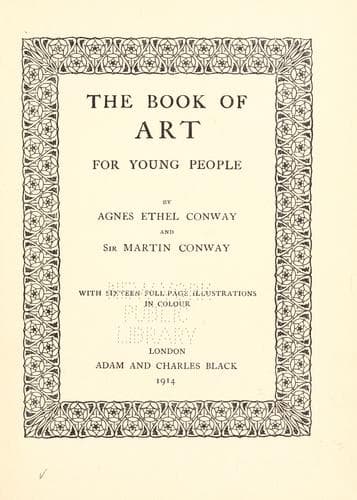
The Book of Art for Young PeopleConway, Agnes Ethel
General
The Book of Art for Young People
Conway, Agnes Ethel
Art -- Juvenile literature; Painting
The Dutch painters carried this still further, particularly in their
pictures of interiors and landscapes. It is the atmosphere in the rooms
that makes Peter de Hoogh's portrayal of interiors so wonderful. In
our little picture the light coming through the window makes the air
almost golden. When this painting of air and tone is set forth by the
exquisite colour of Peter de Hoogh, you see this kind of Dutch
achievement at its best. Cuyp's love of sunshine is rare among Dutch
landscape painters. He suffuses his skies with a golden haze that
bathes his kin and kine alike in evening light. In our picture you
can feel the great height of the sky and the depth of the air between
the foreground and the horizon. The rendering of space is excellent.
But Cuyp has not been content with the features of his native Holland.
He has put an imaginary mountain in the distance and a great hill in
the foreground. It is certainly not a view that Cuyp ever saw in Holland
with his own eyes. He thought that the mountain's upright lines were
good to break the flatness; and the finished composition, if beautiful,
is its own excuse for being.
[Illustration: LANDSCAPE WITH CATTLE
From the picture by Cuyp, in the Dulwich Gallery]
Rembrandt is an exception to all rules, but most of the Dutch painters
did not allow themselves these excursions within their studios to
foreign scenes. They faithfully depicted their own flat country as
they saw it, and added neither hills nor mountains. But they varied
the lighting to express their own moods. Ruysdael's sombre tone befits
the man who struggled with poverty all his life, and died in a hospital
penniless. Cuyp is always sunny. In his pictures, cattle browse at
their ease, and shepherds lounge contented on the grass. He was a
painter of portraits and of figure subjects as well as of landscapes,
and his little groups of men and cattle are always beautifully drawn.
Ruysdael, Hobbema, and many others were landscape painters only, and
some had their figures put in by other artists. Often they did without
them, but in the landscapes of Cuyp, cows generally occupy the
prominent position. The black and white cow in our picture is a fine
creature, and nothing could be more harmonious in colour than the brown
cow and the brown jacket of the herdsman.
There were some painters in Holland in the seventeenth century who
made animals their chief study. Theretofore it had been rare to
introduce them into pictures, except as symbols, like the lion of St.
Jerome, or where the story implied them; or in allegorical pictures,
such as the 'Golden Age.' But at this later time animals had their
share in the increased interest that was taken in the things of daily
life, and they were painted for their handsome sakes, as Landseer
painted them in England fifty years ago.
Public-domain text, read in full here on John Shaqi.
Reviews
Reviews
No reviews yet
Be the first to share your thoughts on this work.
Elsewhere in the archive
Join the Discussion
Join the discussion
Sign in to leave a comment or review.
Sign InorCreate an account