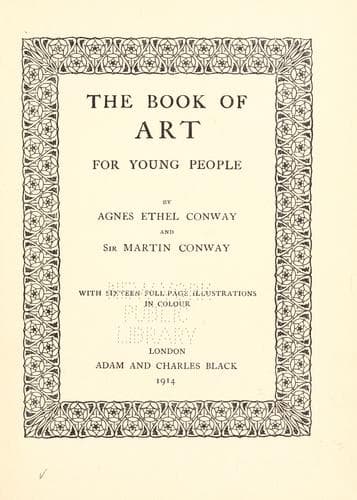
The Book of Art for Young PeopleConway, Agnes Ethel
General
The Book of Art for Young People
Conway, Agnes Ethel
Art -- Juvenile literature; Painting
There was hardly scope enough in Antwerp for two great painters such
as Rubens and Van Dyck, so in 1632 Van Dyck left Flanders and settled
permanently in England, as Court painter to Charles I. All his life
Charles had been an enthusiastic collector of works of art. Born with
a fine natural taste, he had improved it by study, until Rubens could
say of him: 'The Prince of Wales is the best amateur of painting of
all the princes in the world. He has demanded my portrait with such
insistence that he has overcome my modesty, although it does not seem
to me fitting to send it to a Prince of his importance.'
Two of our pictures, the Richard II. diptych and the Edward VI. of
Holbein, were in his collection, besides many we have mentioned, such
as Holbein's 'Erasmus,' Raphael's cartoons, and Mantegna's 'Triumph
of Caesar.' Before Charles came to the throne he had gone to Spain
to woo the daughter of Philip III. The magnificent Titians in the palace
at Madrid extorted such admiration from the Prince that Philip felt
it incumbent upon him as a host and a Spaniard to offer some of them
to Charles. Charles sent his own painter to copy the rest. He kept
agents all over Europe to buy for him, and spent thousands of pounds
in salaries and presents to the artists at his Court. As in the time
of Henry VIII., there were still no first-rate English painters. James
I. had employed a Fleming, and an inferior Dutchman, whom Charles
retained in his service for a time. Then he experimented with a
second-rate Italian artist, who painted some ceilings which still
exist at Hampton Court. Rubens was too much in demand at other Courts
for Charles to have his exclusive service, but the courtly Van Dyck
was a painter after his own heart. For the first time he had found
an artist who satisfied his taste, and Van Dyck a Court in which he
could paint distinction to his heart's content. Charles would have
squandered money on him if he had then had it to squander. As it was,
he paid him far less than he had paid his inferior predecessors, but
Van Dyck continued to paint for him to the end, and by Heaven's mercy
died himself before the crash came, which overthrew Charles and
scattered his collection.
Between the years 1632 and 1642, Van Dyck painted a great number of
portraits of the King. It is from these that we obtain our vivid idea
of the first Charles's gentleness and refinement. He has a sad look,
as though the world were too much for him and he had fallen upon evil
days. We can see him year by year looking sadder, but Van Dyck makes
the sadness only emphasize the distinction.
Public-domain text, read in full here on John Shaqi.
Reviews
Reviews
No reviews yet
Be the first to share your thoughts on this work.
Elsewhere in the archive
Join the Discussion
Join the discussion
Sign in to leave a comment or review.
Sign InorCreate an account