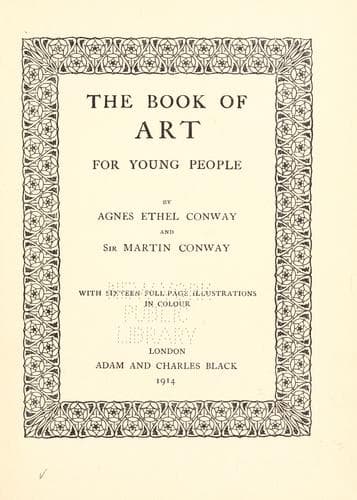
The Book of Art for Young PeopleConway, Agnes Ethel
General
The Book of Art for Young People
Conway, Agnes Ethel
Art -- Juvenile literature; Painting
We have seen how Rembrandt, Peter de Hoogh, Cuyp, Rubens, and Van Dyck
were all contemporaries, born within an area of ground smaller far
than England. Yet the range of their subjects was widely different,
and each painter gave his individuality full play. The desires of the
public were not stereotyped and fixed, as they had been when all alike
wanted their religious aspirations expressed in art. The patrons of
that epoch had various likings, as we have to-day, and the painter
developed along the lines most congenial to himself. Unless he could
make people like what he enjoyed painting, he could not make a living.
If they had no eyes to learn to see, he might remain unappreciated,
like Rembrandt, until long after his death. Yet Van Dyck's portraits
were popular. People could scarcely help enjoying an art that showed
them off to such advantage. Having found a style that suited him, he
adhered to it consistently, thenceforward making but few experiments.
This little picture before us is an admirable example of the gentle
poetic grace and refinement always recalled to the memory by the name
of Van Dyck. So long as men prize the aspect of distinction, which
he was the first Northern painter to express in paint, Van Dyck's
reputation will endure.
CHAPTER XII
VELASQUEZ
During the years in which Van Dyck was painting his beautiful portraits
of the Royal Family of England, another painter, Velasquez, was
immortalizing another Royal Family in the far-away country of Spain.
Cut off by the great mountains of the Pyrenees from the rest of Europe,
Spain did not rank among the foremost powers until after the discovery
of America had brought wealth to her from the gold mines of Mexico
and Peru. In the sixteenth century the King of Spain's dominions,
actual or virtual, covered a great part of Western Europe, excepting
England and France. Germany, Spain, Italy, and the Netherlands, owned
the sovereignty of the Holy Roman Emperor, Charles V. His son was Philip
II. of Spain, the husband of our Queen Mary of England, and his
great-grandson was King Philip IV., the patron of Velasquez, as Charles
I. was of Van Dyck.
Public-domain text, read in full here on John Shaqi.
Reviews
Reviews
No reviews yet
Be the first to share your thoughts on this work.
Elsewhere in the archive
Join the Discussion
Join the discussion
Sign in to leave a comment or review.
Sign InorCreate an account