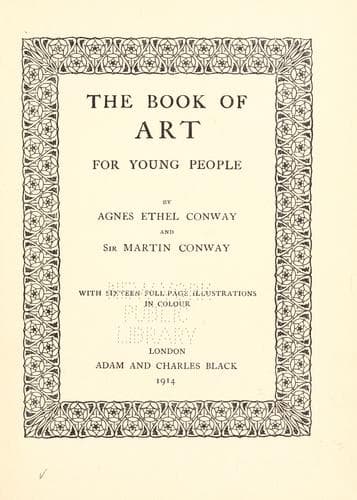
The Book of Art for Young PeopleConway, Agnes Ethel
General
The Book of Art for Young People
Conway, Agnes Ethel
Art -- Juvenile literature; Painting
Velasquez came to Court in the year in which Charles I., as Prince
of Wales, went to Madrid to woo the sister of Philip IV. He painted
her portrait twice, and made an unfinished sketch of Charles, which
has unfortunately been lost. Five years afterwards Rubens was a visitor
at the Spanish Court on a diplomatic errand. The painters took a fancy
to one another, and corresponded for the remainder of their lives.
They must have talked long about their art, and the elder painter,
Rubens, is thought to have promoted in Velasquez a desire to see the
great treasures of Italy. At all events we find that in the next year
he has obtained permission and money from Philip to undertake the
journey, which kept him away from Spain for two years.
There is an amusing page, in doggerel verse, which I remember to have
read some years ago. I trust the translator will pardon the liberty
I am taking in quoting it. It reports a perhaps imaginary conversation
between Velasquez and an Italian painter in Rome. 'The Master' in this
rhyme is Velasquez.
The Master stiffly bowed his figure tall
And said, 'For Raphael, to speak the truth,
--I always was plain-spoken from my youth,--
I cannot say I like his works at all.'
'Well,' said the other, 'if you can run down
So great a man, I really cannot see
What you can find to like in Italy;
To him we all agree to give the crown.'
Velasquez answered thus: 'I saw in Venice
The true test of the good and beautiful;
First, in my judgment, ever stands that school,
And Titian first of all Italian men is.'
Velasquez in Rome was already a ripening artist, whose vision of the
world was quite uncoloured and unshaped by the medieval tradition.
Raphael's pictures with their superhumanly lovely saints, their
unworldly feeling, and their supernaturally clear light, doubtless
imparted pleasure, but not a sympathetic inspiration. Tintoret's
immense creative power and the colours of Titian's painting which
inspired Tintoret's ambition, as we remember--these were the effective
influences Velasquez experienced in Italy. His purchases and his own
later canvases afford that inference. On his return from Italy he
painted a ceremonial picture as wall decoration for one of the palaces
of Philip, and in it we can trace the influence of the great ceremonial
paintings of the Venetians. The picture commemorates the surrender
of Breda in North Brabant, when the famous General Spinola received
its keys for Philip IV. It is far more than a series of separate figures.
Two armies, officers and men, are grouped in one transaction, in one
near and far landscape. It is a picture in which the foreground and
the distances, with the lances of the soldiers and the smoke of battle,
are as indispensable to the whole as are the central figures of the
Dutchman in front handing the city keys to the courtly Spanish general.
Public-domain text, read in full here on John Shaqi.
Reviews
Reviews
No reviews yet
Be the first to share your thoughts on this work.
Elsewhere in the archive
Join the Discussion
Join the discussion
Sign in to leave a comment or review.
Sign InorCreate an account