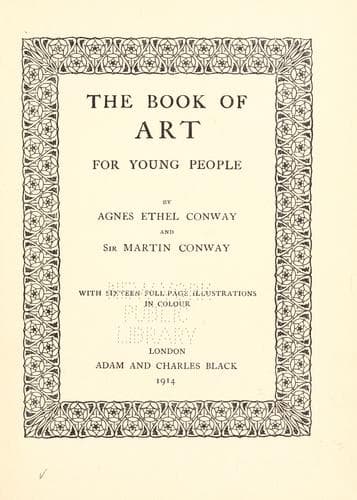
The Book of Art for Young PeopleConway, Agnes Ethel
General
The Book of Art for Young People
Conway, Agnes Ethel
Art -- Juvenile literature; Painting
When Reynolds painted children he delighted in making them act parts.
Even in the 'Age of Innocence' the little girl is looking how very
very innocent. He painted one picture of a small boy, Master Crewe,
dressed to look like Henry VIII. in the style of Holbein. With broad
shoulders and a rich dress, he stands on his sturdy legs quite the
figure of Henry. But the face is one beam of boyish laughter, and on
the top of the little replica of the body of the corpulent monarch
the effect of the childish face is most entertaining.
When Reynolds puts away his ideas of the grand style of Michelangelo
to paint pictures such as these, he is entirely delightful. He
sometimes painted Holy Families and classical subjects, but the more
the spirit of medieval sacred art has sunk into us, the less can we
admire modern versions of the old subjects. The sacred paintings of
the Middle Ages owe some of their charm to the fact that they do not
make upon us the impression of life. In Reynolds' Holy Families, the
Mother and Child are painted with all the skill of a modern artist
and look as human as his portraits of the Duchess of Devonshire and
her baby. It is no longer possible to think of them as anything but
portraits of the models whom Reynolds employed for his picture.
Another method that modern artists have sometimes adopted in painting
sacred subjects, is to imitate the faulty drawing and incomplete
representation of life which are present in the art of the Old Masters.
But this conscious imitation of bygone ignorance beguiles no one who
has once felt the charm of the painters before Raphael.
Reynolds' great contemporary, Gainsborough, has been called 'a child
of nature.' He would have liked to live in the country always and paint
landscapes. He did paint many of his native Suffolk, but in his day
landscapes were unsaleable, so he was driven to the town and to portrait
painting to make a living. Less than Reynolds a painter of character,
Gainsborough reproduced the superficial expression of his sitters.
But he had so natural an eye for grace and beauty, that his portraits
always please. He did not attempt Reynolds' wide range of subjects
or the same difficulties of pose. Of Reynolds he said: 'How various
he is,' but his admiration did not make him stray from his natural
path to attempt the variety of another. Reynolds, equally admiring,
said of him: 'I cannot make out how he produces his effects.' Perhaps
Gainsborough did not know either. He does seem to paint by instinct,
and successive pictures became more pleasing. Buoyant in his life as
in his art, his last words were: 'We are all going to Heaven, and Van
Dyck is of the company.'
Another great contemporary painter was Romney, whose portraits of
ladies are delightful. Figured as nymphs too, they are so buoyant with
bright expressions and wayward locks, that one wishes he had depicted
in their faces a soul.
Public-domain text, read in full here on John Shaqi.
Reviews
Reviews
No reviews yet
Be the first to share your thoughts on this work.
Elsewhere in the archive
Join the Discussion
Join the discussion
Sign in to leave a comment or review.
Sign InorCreate an account