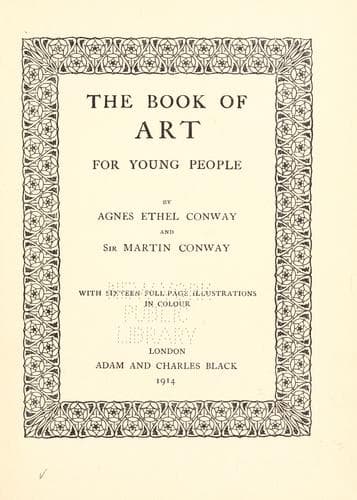
The Book of Art for Young PeopleConway, Agnes Ethel
General
The Book of Art for Young People
Conway, Agnes Ethel
Art -- Juvenile literature; Painting
As Venice enriched his vision of colour, Rome stimulated him to paint
new subjects suggested by ancient history and mythology. He knew little
of Roman history or classical literature, yet enough to kindle his
imagination; witness his 'Rise and Fall of the Carthaginian Empire'
in the National Gallery. In these the figures are of no importance.
The pictures still are landscapes, but freed from the necessity of
being like any particular place. In work such as this, Turner had but
one predecessor, the French Claude Lorraine. While the Dutchmen of
the seventeenth century were painting their own country beautifully,
Claude was living in Rome, creating imaginary landscapes. He called
his pictures by the names of Scriptural incidents, and placed figures
in the foreground as small and unessential as those of Turner. These
classical landscapes, with their palaces and great flights of steps
leading down to some river's edge, and the sea in the distance covered
with boats carrying fantastic sails, never for a moment make the
impression of reality. But they are beautiful compositions, designed
to please the eye and stimulate the fancy, and are even attractive
by virtue of their novel aloofness from the actual world.
Turner set himself to rival Claude in his ideal landscapes, founded
upon the stories of the ancient world. In his picture of 'Dido building
Carthage,' he painted imaginary palaces, rivers, and stately ships,
in the same cool colouring as Claude, and bequeathed his picture to
the National Gallery, on condition that it should hang for ever between
two pictures by Claude to challenge their superiority. Opinions are
divided as to the rank of Turner's 'Carthage,' so when you go to the
National Gallery, you must look at them both and prepare to form a
preference.
Turner was incited to this rivalry with Claude by the popularity that
painter enjoyed among English collectors of the day, who were less
eager to buy Turner's great oil-paintings than those of his predecessor.
Incidentally this rivalry was the origin of the great series of
etchings executed by or for him, known as _The Book of Studies (Liber
Studiorum)_. This book was suggested by Claude's _Libri di Verita_,
six volumes of his own drawings (of pictures he himself had painted
and sold) made in order to identify his own, and detect spurious,
productions. But Turner's book was designed to show his power in the
whole range of landscape art. The drawings were carefully finished
productions, work by which he was willing to be judged, and many of
them he etched with his own hands. His favourite haunts, the abbeys
of Scotland and Yorkshire, the harbours of Kent, the mountains of
Switzerland, the lochs of Scotland, and the River Wye, he chose as
illustrating his best power over architecture, sea, mountain, and
river. He repeated several of the same subjects later in oils, such
as the pearly hazy 'Norham Castle' in the Tate Gallery.
Public-domain text, read in full here on John Shaqi.
Reviews
Reviews
No reviews yet
Be the first to share your thoughts on this work.
Elsewhere in the archive
Join the Discussion
Join the discussion
Sign in to leave a comment or review.
Sign InorCreate an account