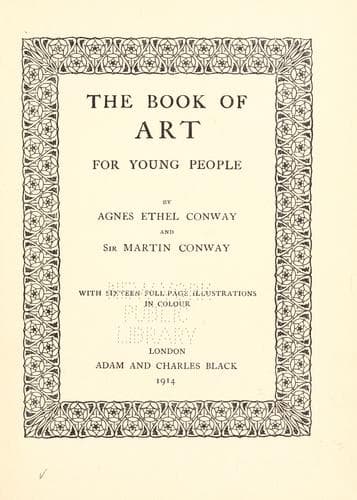
The Book of Art for Young PeopleConway, Agnes Ethel
General
The Book of Art for Young People
Conway, Agnes Ethel
Art -- Juvenile literature; Painting
Other artists have interpreted scenery beautifully, and a few have
painted ideal landscapes, but who besides Turner has ever united such
diversities of power? He continued to paint water-colour sketches to
the end of his life, for these were appreciated by a public that did
not understand, and neglected to buy, his oil-paintings. He sketched
throughout France and Switzerland for various publications as he had
sketched in England. Time has not damaged these drawings, as it has
the pictures in oil, for to the end of his life Turner sometimes used
bad materials. Even the sky of the 'Fighting Temeraire' has faded
considerably since it was painted, and others of his oil-pictures are
mere shadows of their former selves. It is pathetic to look upon the
wreck of work not a century old and to wonder how much of it will be
preserved for future generations.
Turner himself deemed the 'Temeraire' one of his best pictures, and
from the beginning intended to bequeath it to the National Gallery,
refusing to sell it for any price whatever.
There's a far bell ringing,
At the setting of the sun,
And a phantom voice is singing
Of the great days done.
There's a far bell ringing,
And a phantom voice is singing
Of renown for ever clinging
To the great days done.
Now the sunset breezes shiver,
_Temeraire! Temeraire!_
And she's fading down the river,
_Temeraire! Temeraire!_
Now the sunset breezes shiver,
And she's fading down the river,
But in England's song for ever
She's the '_Fighting Temeraire_.'[4]
[Footnote 4: _The Fighting Temeraire_. Henry Newbolt.]
CHAPTER XV
THE NINETEENTH CENTURY
Since we began our voyagings together among the visionary worlds of
the great painters, five hundred and thirty years ago, at the accession
of King Richard II., we have journeyed far and wide, trudging from
the rock where Cimabue found the boy Giotto drawing his sheep's
likeness. The battleship of Turner has now brought us to the
mid-nineteenth century, a time within the memories of living men, and
still our journey is not ended.
Hitherto we have been guided in our general preference for certain
artists and certain pictures by the concurring opinion of the best
judges of many successive generations. But while we are looking at
modern paintings, we cannot say, as some one did, that in our opinion,
'which is the correct one,' such and such a picture is worthy to rank
with Titian. The taste of one age is not the taste of another. Who
can surely pronounce the consensus of opinion to-day? Who can guess
if it will concur with that of future decades--of future centuries?
We can but hope that learning to see and enjoy the recognized
masterpieces of the past will teach us what to like best among the
masterpieces of the present.
Public-domain text, read in full here on John Shaqi.
Reviews
Reviews
No reviews yet
Be the first to share your thoughts on this work.
Elsewhere in the archive
Join the Discussion
Join the discussion
Sign in to leave a comment or review.
Sign InorCreate an account