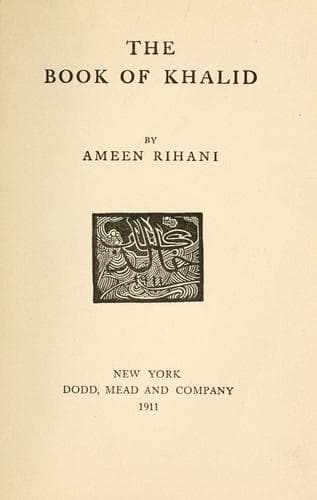
Arab Americans -- Fiction; Immigrants -- New York (State) -- New York -- Fiction
"After supper, he orders me a narghilah, and winds for my entertainment
that horrible instrument of torture." Khalid did not seem to mind it;
but he was anxious about the sacred peace of the hills, sleeping in
the bosom of night. My Name is Billy Muggins, I Wish I Had a Pal Like
You, Tickle Me, Timothy, and such like ragtime horrors come all the
way from America to violate the antique grandeur and beauty of the
Lebanon hills. That is what worried Khalid. And he excuses himself,
saying, "I am waygone from the day's wayfaring." The instrument of
torture is stopped, therefore, and he is shown into a room where a
mattress is spread for him on the floor.
"In the morning," he continues, "mine host accompanies me through the
populous village, which is noted for its industries. Of all the
Lebanon towns, this is, indeed, the busiest; its looms, its potteries,
and its bell foundries, are never idle. And the people cultivate
little of the silk worm; they are mostly artisans. American cotton
they spin, and dye, and weave into substantial cloth; Belgian iron
they melt and cast into bells; and from their native soil they dig the
clay which they mould into earthenware. The tintinnabulations of the
loom can be heard in other parts of the Lebanons; but no where else
can the vintner buy a dolium for his vine, or the housewife, a pipkin
for her oil, or the priest, a bell for his church. The sound of these
foundries' anvils, translated into a wild, thrilling, far-reaching
music, can be heard in every belfry and bell-cote of Syria.
"We descend to the potteries below, not on the carriage road which
serpentines through the village, and which is its only street, but
sheer down a steep path, between the noise of the loom and spinning
wheel and the stench of the dyeing establishments. And here is the
real potter and his clay, not the symbol thereof. And here is the
pottery which is illustrated in the Bible. For in the world to-day, if
we except the unglazed tinajas of the Pueblo Indians, nothing, above
ground at least, can be more ancient and primitive. Such a pitcher, I
muse, did Rebekah carry to the well; with such a Jar on her shoulder
did Hagar wander in the wilderness; and in such vessels did the widow,
by Elijah's miracle, multiply her jug of oil.
Public-domain text, read in full here on John Shaqi.
Reviews
Reviews
No reviews yet
Be the first to share your thoughts on this work.
Elsewhere in the archive
Join the Discussion
Join the discussion
Sign in to leave a comment or review.
Sign InorCreate an account