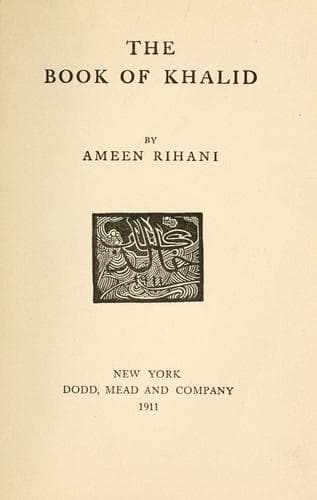
Arab Americans -- Fiction; Immigrants -- New York (State) -- New York -- Fiction
"I muse meanwhile on Time, who sees in a citadel of the ancient
Phoenicians, after many thousand years, that same propensity for
gold, that same instinct for trade. The Phoenicians worked gold
mines in Thrace, and the Syrians, their descendants, are working
gold mines in America. But are we as daring, as independent, as
honest? I am not certain, however, if those Phoenicians had anything
to do with bubbles. My friend Sanchuniathon writes nothing on the
subject. History records not a single instance of a gold-mine
bubble in Thrace, or a silver ditto in Africa. Apart from this, have
we, the descendants of those honest Phoenicians, any of their
inventive skill and bold initiative? They taught other nations the
art of ship-building; we can not as much as learn from other
nations the art of building a gig. They transmitted to the people
of the West a knowledge of mathematics, weights, and measures; we
can not as much as weigh or measure the little good Europe is
transmitting to us. They always fought bravely against their
conquerors, always gave evidence of their love of independence; and we
dare not raise a finger or whisper a word against the red Tyrant by
whom we are degraded and enslaved. We are content in paying tribute
to a criminal Government for pressing upon our necks the yoke and
fettering hopelessly our minds and souls--and my brave Phoenicians,
ah, how bravely they thought and fought. What daring deeds they
accomplished! what mysteries of art and science they unveiled!
"On these shores they hammered at the door of invention, and,
entering, showed the world how glass is made; how colours are
extracted from pigments; how to measure, and count, and communicate
human thought. The swarthy sons of the eternal billows, how shy they
were of the mountains, how enamoured of the sea! For the mountains, it
was truly said, divide nations, and the seas connect them. And my
Phoenicians, mind you, were for connection always. Everywhere, they
lived on the shores, and ever were they ready to set sail.
"In this mammoth loophole, measuring about ten yards in length,--this
the thickness of the wall--I muse of another people skilled in the art
of building. But between the helots who built the pyramids and the
freemen who built this massive citadel, what a contrast! The Egyptian
mind could only invent fables; the Phoenician was the vehicle of
commerce and the useful arts. The Egyptians would protect their dead
from the tyranny of Time; the Phoenicians would protect themselves,
the living, from the invading enemy: those based their lives on the
vagaries of the future; these built it on the solid rock of the
present...."
* * * * *
Public-domain text, read in full here on John Shaqi.
Reviews
Reviews
No reviews yet
Be the first to share your thoughts on this work.
Elsewhere in the archive
Join the Discussion
Join the discussion
Sign in to leave a comment or review.
Sign InorCreate an account