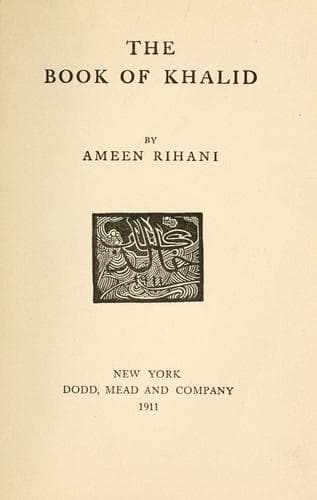
Arab Americans -- Fiction; Immigrants -- New York (State) -- New York -- Fiction
But he can not even work. On the table before him is a pile of
newspapers from all parts of Syria and Egypt--even from India--and
all simmering, as it were, with Khalid's name, and Khalidism, and
Khalid scandals. He is hailed by some, assailed by others; glorified
and vilified in tawdry rhyme and ponderous prose by Christians and
Mohammedans alike. "Our new Muhdi," wrote an Egyptian wit (one of
those pallid prosers we once met in the hasheesh dens, no doubt), "our
new Muhdi has added to his hareem an American beauty with an Oriental
leg."
What he meant by this only the hasheesh smokers know. "An instrument in
the hands of some American speculators, who would build sky-scrapers
on the ruins of our mosques," wrote another. "A lever with which
England is undermining Al-Islam," cried a voice in India. "A base one
in the service of some European coalition, who, under the pretext of
preaching the spiritualities, is undoing the work of the Revolution.
The gibbet is for ordinary traitors; for him the stake," etc., etc.
On the other hand, he is hailed as the expected one,--the true leader,
the real emancipator,--"who has in him the soul of the East and the
mind of the West, the builder of a great Asiatic Empire." Of course,
the foolish Damascene editor who wrote this had to flee the country
the following day. But Khalid's eyes lingered on that line. He read it
and reread it over and over again--forward and backward, too. He
juggled, so to speak, with its words.
How often people put us, though unwittingly, on the path we are
seeking, he thought. How often does a chance word uttered by a
stranger reveal to us our deepest aims and purposes.
Before him was ink and paper. He took up the pen. But after scrawling
and scribbling for ten minutes, the sheet was filled with circles and
arabesques, and the one single word Dowla (Empire).
He could not think: he could only dream. The soul of the East--The
mind of the West--the builder of a great Empire. The triumph of the
Idea, the realisation of a great dream: the rise of a great race who
has fallen on evil days; the renaissance of Arabia; the reclaiming of
her land; the resuscitation of her glory;--and why not? especially if
backed with American millions and the love of a great woman. He is
enraptured. He can neither sleep nor think: he can but dream. He puts
on his jubbah, refills his cigarette box, and walks out of his room.
He paces up and down the hall, crowning his dream with wreaths of
smoke. But the dim lights seemed to be ogling each other and smiling,
as he passed. The clocks seemed to be casting pebbles at him. The
silence horrified him. He pauses before a door. He knocks--knocks
again.
The occupant of that room was not yet asleep. In fact, she, too, could
not sleep. The clock in the hall outside had just struck one, and she
was yet reading. After inquiring who it was that knocked, she puts on
a kimono and opens the door. She is surprised.
"Anything the matter with you?"
Public-domain text, read in full here on John Shaqi.
Reviews
Reviews
No reviews yet
Be the first to share your thoughts on this work.
Elsewhere in the archive
Join the Discussion
Join the discussion
Sign in to leave a comment or review.
Sign InorCreate an account