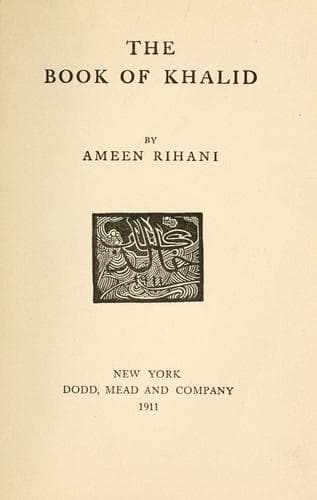
Arab Americans -- Fiction; Immigrants -- New York (State) -- New York -- Fiction
"But why not try to understand me? Can you not find in my ideas the
very essence of Buhaism? Can you not come up to my height and behold
there the star that you have taken for your guide? My Truth, Jamïlah,
can you not see that? Love and Faith, free from all sectarianism and
all earthly authority,--what is Buhaism or Mohammedanism or
Christianity beside them? Moreover, I have a mission. And to love me
you must believe in _me_, not in the Buha. You laugh at my dream. But
one day it will be realised. A great Arab Empire in the border-land of
the Orient and Occident, in this very heart of the world, this Arabia,
this Egypt, this Field of the Cloth of Gold, so to speak, where the
Male and Female of the Spirit shall give birth to a unifying faith, a
unifying art, a unifying truth--"
"Vagaries, chimeras," interrupted Mrs. Gotfry. "Buhaism is established,
and it needs a great apostle. It needs you; it will have you. I will
have you. Your destiny is interwoven with mine. You can not flee it,
do what you may. We are ruled by our stars, Khalid. And if you do not
realise this now, you will realise it to-morrow. Here, give me your
hand."
"I can not."
"Very well, then. Good-bye--_au revoir_. In three months you will
change your mind. In three months I will return to the East and find
you waiting for me, even here in this desert. Think on it, and take
care of yourself. _Au revoir._"
In this strange, mysterious manner, after pacing for hours on the sand
in the sheen of the full moon, Mrs. Gotfry says farewell to Khalid.
He sits on a rock near his tent and ponders for hours. He seeks in the
stars, as it were, a clue to the love of this woman, which he first
thought to be unfathomable. There it is, the stars seem to say. And he
looks into the sand-grave near him, where little Najib practises how
to die. Yes; a fitting symbol of the life and love called modern,
boasting of freedom. They dance their dervish dance, these people,
even like Khalid's little Najib, and fall into their sand-graves, and
fold their arms and smile: "We are in love--or we are out of it."
Which is the same. No: he'll have none of this. A heart as simple as
this desert sand, as deep in affection as this heaven, untainted by
the uncertainties and doubts and caprices of modern life,--only in
such a heart is the love that endures, the love divine and eternal.
He goes into Najma's tent. The mother and her child are sound asleep.
He stands between the bed and the cot contemplating the simplicity and
innocence and truth, which are more eloquent in Najib's brow than
aught of human speech. His little hand raised above his head seems to
point to a star which could be seen through an opening in the canvas.
Was it his star--the star that he saw in the sand-grave--the star that
is calling to him?--
But let us resume our narration.
A fortnight after Mrs. Gotfry's departure Shakib leaves the camp to
live in Cairo. He is now become poet-laureate to one of the big
pashas.
Public-domain text, read in full here on John Shaqi.
Reviews
Reviews
No reviews yet
Be the first to share your thoughts on this work.
Elsewhere in the archive
Join the Discussion
Join the discussion
Sign in to leave a comment or review.
Sign InorCreate an account