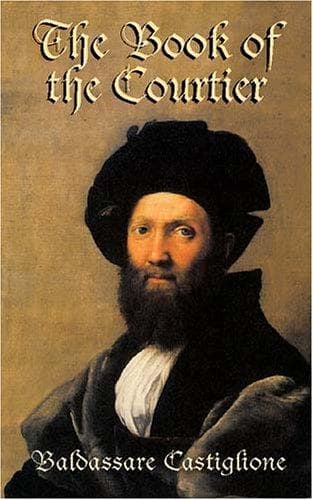
The Book of the CourtierCastiglione, Baldassarre, conte
History
The Book of the Courtier
Castiglione, Baldassarre, conte
Courtesy -- Early works to 1800; Courts and courtiers -- Early works to 1800
“‘This is not hardness of heart, but a silent lesson from the lady to
teach you that she is never pleased with an importunate suitor.’
“The other replied:
“‘Nay, it is a warning to him that while she never grants what is asked
of her, still she likes to be entreated for it.’
“You see how the lady’s failure to send the poor man away, gave rise to
one saying of grave censure, one of moderate praise, and another of
biting satire.
48.—“Proceeding now to declare the kinds of pleasantries that are
pertinent to our subject, I say that in my opinion there are three
varieties, although messer Federico mentioned only two: namely, that
which consists in rendering the effect of a thing by means of urbane and
amusing long narrative, and that which consists in the swift and keen
readiness of a single phrase. But we will add a third sort called
practical joking, in which long narratives and short sayings have place,
and also some action.
“Now the first, which consists in continuous talk, is of such sort as
almost to amount to story-telling. And to give you an instance: just at
the time when Pope Alexander the Sixth died and Pius the Third was
created pope,[193] your fellow Mantuan, my lady Duchess, messer Antonio
Agnello,[194] being at Rome and in the palace, happened to speak of the
death of the one pope and of the other’s creation, and in discussing
this with some of his friends, he said:
“‘My Lords, even in the days of Catullus[195] doors began to speak
without a tongue and to listen without ears, and thus to reveal
adulteries. Now, although men are not of such worth as they were in
those times, it may be that the doors (many of which are made of antique
marbles, at least here in Rome) have the same powers that they then had;
and for my part I believe that these two here could clear away all our
doubts if we cared to learn from them.’
“Then the gentlemen present were very curious, and waited to see how the
affair was going to end. Whereupon messer Antonio, continuing to walk up
and down, raised his eyes as if by chance to one of the two doors of the
hall in which they were strolling, stopped a moment, and pointed out to
his companions the inscription over it, which was the name of Pope
Alexander, followed by a V and an I, signifying Sixth as you know; and
he said:
“‘See what the door says: _Alessandro Papa vi_, which means that he
became pope by the violence that he used, and that he accomplished more
by violence than by reason. Now let us see if from the other we can
learn anything about the new pope.’ And turning to the other door as if
by accident, he showed the inscription, N PP V, which signified
_Nicolaus Papa Quintus_;[196] and he at once said: ‘Alas, bad news; this
one says, _Nihil Papa Valet_.’
[Illustration:
POPE ALEXANDER VI
RODERIGO LENZUOLI (BORGIA)
1431-1503
]
Public-domain text, read in full here on John Shaqi.
Reviews
Reviews
No reviews yet
Be the first to share your thoughts on this work.
Elsewhere in the archive
Join the Discussion
Join the discussion
Sign in to leave a comment or review.
Sign InorCreate an account