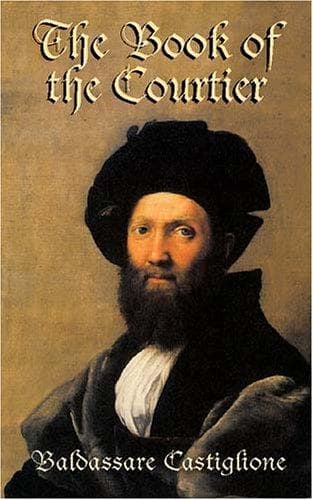
The Book of the CourtierCastiglione, Baldassarre, conte
History
The Book of the Courtier
Castiglione, Baldassarre, conte
Courtesy -- Early works to 1800; Courts and courtiers -- Early works to 1800
“Somewhat of the same fashion was the retort made by Scipio Nasica[278]
to Ennius. Once when Scipio went to Ennius’s house to speak with him and
called him down from the street, one of his maids replied that he was
not at home; and Scipio distinctly heard Ennius himself tell the maid to
say he was not at home, and so went away. Not long afterwards Ennius
came to Scipio’s house and likewise called to him from below; whereupon
Scipio himself replied in a loud voice that he was not at home. Then
Ennius replied: ‘How? Do I not know thy voice?’ Scipio said: ‘Thou art
too rude. The other day I believed thy maid when she said thou wert not
at home, and now thou wilt not believe the like from me in person.’
76.—“It is also a fine thing when a man is struck in the very same place
where he first struck his fellow. As in the case of messer Alonso
Carillo,[279] who, being at the Spanish court and having committed some
youthful peccadilloes of no great importance, was put in prison by the
king’s order and left there overnight. The next day he was taken out,
and so going to the palace in the morning, he reached the hall where
there were many cavaliers and ladies. And as they were laughing at his
imprisonment, my lady Boadilla[280] said: ‘Signor Alonso, your mishap
weighed on me heavily, for all your acquaintance thought the king would
have you hanged.’ Then Alonso said quickly: ‘My Lady, I was much afraid
of it myself; but then I had hope that you would ask me to be your
husband.’ You see how sharp and clever this was, because in Spain (as in
many other countries too) the custom is that when a man is led to the
gallows, his life is given him if a public courtesan begs him for her
husband.
[Illustration:
RAPHAEL
1483-1520
]
Enlarged from a part of Weinwurm’s photograph (no. 1384) of the
portrait, in the National Gallery at Buda-Pest, by Sebastiano
Luciani “del Piombo” (1485-1547). In the Scarpia collection at La
Motta di Livenza, this picture passed for years as a portrait by
Raphael of the Ferrarese courtier-poet Antonio Tebaldeo. On purely
intrinsic evidence, both Morelli and Berenson identify it as a
portrait of Raphael at the age of 26 or 27 years.
“In this manner also the painter Raphael replied to two cardinals with
whom he was on familiar terms, and who (to make him talk) were finding
fault in his presence with a picture that he had painted,—in which St.
Peter and St. Paul were represented,—saying that these two figures were
too red in the face. Then Raphael at once said: ‘My Lords, be not
concerned; because I painted them so with full intention, since we have
reason to believe that St. Peter and St. Paul are as red in Heaven as
you see them here, for shame that their Church should be governed by
such men as you.’[281]
Public-domain text, read in full here on John Shaqi.
Reviews
Reviews
No reviews yet
Be the first to share your thoughts on this work.
Elsewhere in the archive
Join the Discussion
Join the discussion
Sign in to leave a comment or review.
Sign InorCreate an account