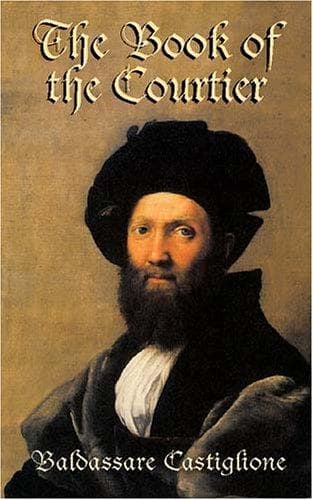
The Book of the CourtierCastiglione, Baldassarre, conte
History
The Book of the Courtier
Castiglione, Baldassarre, conte
Courtesy -- Early works to 1800; Courts and courtiers -- Early works to 1800
inn, all dishevelled, capless, pale with anger and shame; for nothing he
said availed him, partly because the Frenchmen did not understand him,
and also partly because, as I walked along leading them to the inn, I
kept lamenting the poor man’s misfortune in being thus stricken mad.
89.—“Now, as we have said, it would be possible to talk at length about
practical jokes; but suffice it to repeat that the occasions which give
opportunity for them are the same as in the case of pleasantries.
Moreover we have an infinity of examples because we see them every day.
Among others there are many amusing ones in the _Novelle_ of Boccaccio,
like those which Bruno and Buffalmacco played upon their friend
Calandrino and upon master Simone,[319] and many others played by women,
that are truly clever and fine.
“I remember having known in my time many other amusing men of this sort,
and among others a certain Sicilian student at Padua, called
Ponzio;[320] who once saw a peasant with a pair of fat capons. And
pretending that he wished to buy them, he struck a bargain, and told the
fellow to come home with him and get some breakfast besides the price
agreed on. So he led the peasant to a place where there was a bell-tower
standing apart from its church[321] so that one could walk around it;
and just opposite one of the four sides of the tower was the end of a
little lane. Here Ponzio, who had already settled what he meant to do,
said to the peasant: ‘I have wagered these capons with one of my
friends, who says that this tower measures quite forty feet around,
while I say it does not. And just before I found you, I had bought this
twine to measure it. Now, before we go home I wish to find out which of
the two has won.’ And so saying, he drew the twine from his sleeve, gave
one end of it to the peasant, and said: ‘Hand them here.’ Thereupon he
took the capons, and holding the other end of the twine as if he were
going to measure, he started to walk around the tower, first making the
peasant stay and hold the twine against that side of it which was
farthest from the one that looked up the little lane. When he reached
this other side, he stuck a nail into the wall, tied the twine to it,
and leaving the man there he quietly went off with the capons up the
little lane. The peasant stood still a long time waiting for Ponzio to
finish the measurement; at last,—after he had several times said: ‘What
are you doing there so long?’—he went to look, and found that it was not
Ponzio who was holding the twine, but a nail stuck in the wall, and that
this was all the pay left him for the capons. Ponzio played numberless
tricks of this sort.
Public-domain text, read in full here on John Shaqi.
Reviews
Reviews
No reviews yet
Be the first to share your thoughts on this work.
Elsewhere in the archive
Join the Discussion
Join the discussion
Sign in to leave a comment or review.
Sign InorCreate an account