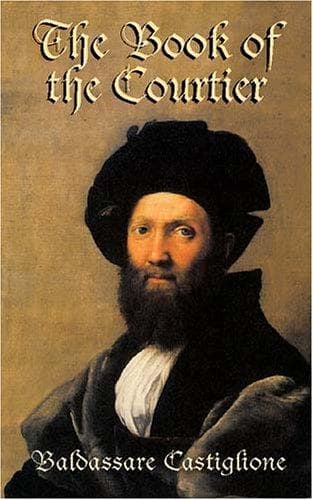
The Book of the CourtierCastiglione, Baldassarre, conte
History
The Book of the Courtier
Castiglione, Baldassarre, conte
Courtesy -- Early works to 1800; Courts and courtiers -- Early works to 1800
“I think, then, that such divine princes as these have been sent by God
on earth, and by Him made to resemble one another in youth, in martial
power, in state, in beauty and bodily shape, to the end that they may be
of one accord for this good purpose also. And if there must ever be any
envy or emulation among them, it may be solely in wishing to be each the
first and most fervent and zealous for so glorious an enterprise.
“But let us leave this discourse and return to our subject. I say, then,
messer Cesare, that the things which you wish the prince to do are very
great and worthy of much praise; but you ought to understand that if he
does not know that which I have said he ought to know, and has not
formed his mind after that pattern and directed it to the path of
virtue, he will hardly know how to be magnanimous, generous, just,
courageous, foreseeing, or to possess any of those other qualities that
are looked for in him. Nor yet would I have him such merely for the sake
of being able to exercise these qualities: for just as those who build
are not all good architects, so those who give are not all generous;
because virtue never harms any man, and there are many who rob in order
to give away, and thus are generous with the property of others; some
give to those they ought not, and leave in misfortune and distress those
to whom they are beholden; others give with a certain bad grace and
almost spite, so that men see they do so on compulsion; others not only
make no secret of it, but call witnesses and almost proclaim their
generosities; others foolishly empty the fountain of their generosity at
a draught, so that it can be no more used again.
[Illustration:
PRINCE HENRY OF WALES
AFTERWARDS HENRY VIII OF ENGLAND
1491-1547
]
Reduced from Walker and Boutall’s photograph of an anonymous portrait
(no. 157) in the National Portrait Gallery at London. Painted on
copper, and formerly owned by Mr. Barrett at Lee Priory, Kent, the
picture was acquired by the Gallery from the Messrs. Graves in 1863.
40.—“Hence in this, as in other things, it is needful to know and to
govern one’s self with that foresight which is the necessary companion
of all the virtues; which being midway are near the two extremes—that
is, the vices; and thus he who does not know, easily runs into them. For
just as it is difficult to find the central point in a circle, which is
the mean, so is it difficult to find the point of virtue set midway
between the two extremes (vicious, the one because of excess, the other
because of deficiency); and to these we are inclined, sometimes to one
and sometimes to the other. We perceive this in the pleasure or
displeasure that we feel within us, for by reason of the one we do that
which we ought not, and by reason of the other we fail to do that which
we ought; but the pleasure is much the more dangerous, because our
judgment allows itself to be easily corrupted by it.
Public-domain text, read in full here on John Shaqi.
Reviews
Reviews
No reviews yet
Be the first to share your thoughts on this work.
Elsewhere in the archive
Join the Discussion
Join the discussion
Sign in to leave a comment or review.
Sign InorCreate an account