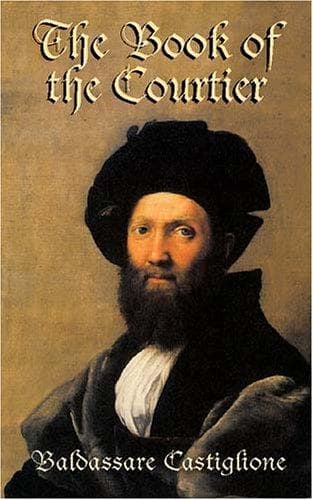
The Book of the CourtierCastiglione, Baldassarre, conte
History
The Book of the Courtier
Castiglione, Baldassarre, conte
Courtesy -- Early works to 1800; Courts and courtiers -- Early works to 1800
“I should be sorry, my Lady, that my saying it is permissible for old
men to love should be a reason for these ladies to regard me as old;
therefore please to give this task to someone else.”[473]
My lady Duchess replied:
“You ought not to shun being reputed old in wisdom, even if you are
young in years; so speak on, and make no more excuse.”
Messer Pietro said:
“Indeed, my Lady, if I must talk about this matter, I should need to go
take counsel with my Lavinello’s Hermit.”[474]
Then my lady Emilia said, half vexed:
“Messer Pietro, there is no one in the company who is more disobedient
than you; therefore it will be well for my lady Duchess to inflict some
chastisement upon you.”
Messer Pietro said, again smiling:
“Be not angry with me, my Lady, for love of God; for I will tell what
you wish.”
“Then tell it at once,” replied my lady Emilia.
51.—Whereupon messer Pietro, having first remained silent awhile, then
settled himself a little as if about to speak of something important,
and spoke thus:[475]
“My Lords, in order to prove that old men can love not only without
blame but sometimes more happily than young men, it will be needful for
me to make a little discourse to explain what love is, and in what
consists the happiness that lovers may enjoy. So I pray you hear me with
attention, for I hope to make you see that there is no man here whom it
does not become to be in love, even though he were fifteen or twenty
years older than my lord Morello.”
And then after some laughter, messer Pietro continued:
“I say, then, that according to the definition of the ancient sages love
is naught but a certain desire to enjoy beauty; and as desire longs only
for things that are perceived, perception must needs always precede
desire, which by its nature wishes good things, but in itself is blind
and does not perceive them. Therefore nature has so ordained that to
every faculty of perception there is joined a certain faculty of
appetite; and since in our soul there are three modes of perceiving,
that is, by sense, by reason, and by intellect: from sense springs
appetite, which we have in common with the brutes; from reason springs
choice, which is peculiar to man; from the intellect, by which man is
able to commune with the angels, springs will. Thus, just as sense
perceives only things that are perceptible by the senses, appetite
desires the same only; and just as intellect is directed solely to the
contemplation of things intellectual, the will feeds only upon spiritual
benefits. Being by nature rational and placed as a mean between these
two extremes, man is able at will (by descending to sense or mounting to
intellect) to turn his desires now in the one direction and now in the
other. In these two ways, therefore, it is possible to desire beauty,
which universal name applies to all things (whether natural or
artificial) that are framed in good proportion and due measure according
to their nature.
[Illustration:
PIETRO BEMBO
1470-1547
]
Public-domain text, read in full here on John Shaqi.
Reviews
Reviews
No reviews yet
Be the first to share your thoughts on this work.
Elsewhere in the archive
Join the Discussion
Join the discussion
Sign in to leave a comment or review.
Sign InorCreate an account