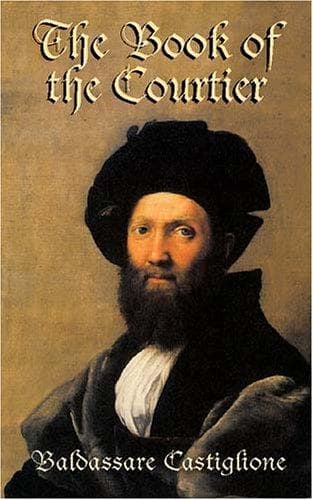
The Book of the CourtierCastiglione, Baldassarre, conte
History
The Book of the Courtier
Castiglione, Baldassarre, conte
Courtesy -- Early works to 1800; Courts and courtiers -- Early works to 1800
Note 34 page 10. Pope JULIUS II, (born 1443; died 1513), was Giuliano,
the second son of Raffaele della Rovere (only brother of Pope Sixtus IV)
and Teodora Menerola. Made a cardinal soon after his uncle’s election,
he was loaded with sees and offices, including the legateship of Picene
and Avignon, which latter occasioned his prolonged absence from Italy
and afforded him an escape from the wiles of his inveterate enemy
Alexander VI. The outrages with which Alexander sought to punish his
sturdy opposition to the scandals of the Borgian court, aroused in him a
fierceness of spirit that was alien to the seeming mildness of his early
character and became the bane of his own pontificate. His younger
brother Giovanni married a sister of Duke Guidobaldo, a union that
cemented the friendship between the two families and furnished the Duchy
of Urbino an heir in the person of Francesco Maria della Rovere. When
Julius engaged Michelangelo to design his tomb, the old basilica of St.
Peter’s was found too small to contain it, whereupon the pontiff is said
to have decreed that a new church be built to receive it, and blessed
the laying of the first stone shortly before setting out on his campaign
against Bologna in 1506. In 1508 he formed the League of Cambray for the
recovery of certain papal fiefs appropriated by Venice at the time of
Cesare Borgia’s downfall, and in 1511 the so-called Holy League for the
expulsion of the French from Italy. Italian unity was the unavowed but
real goal at which his policy aimed.
Although a munificent patron of art and letters, Julius was frugal and
severe,—a man of action rather than a scholar or theologian. In giving
Michelangelo directions for the huge bronze statue at Bologna, he said:
“Put a sword in my hand; of letters I know nothing.” Another of his
reported sayings is: “If we are not ourselves pious, why should we
prevent others from being so?”
Note 35 page 10. Although unexpressed in the original, the word
‘learned’ seems necessary to complete the obvious meaning of the
passage.
From his tutor Odasio of Padua, we learn that in his boyhood Guidobaldo
was even for the time exceptionally fond of study. He could repeat whole
treatises by heart ten years after reading them, and never forgot what
he resolved to retain. Besides his classical attainments, he appreciated
the Italian poets, and showed peculiar aptitude for philosophy and
history.
Note 36 page 10. The Italian _piacevolezza_ conveys somewhat the same
suggestion of humour which the word ‘pleasantness’ carried with it to
the English of Elizabeth’s time, and which still survives in our
‘pleasantry.’
Public-domain text, read in full here on John Shaqi.
Reviews
Reviews
No reviews yet
Be the first to share your thoughts on this work.
Elsewhere in the archive
Join the Discussion
Join the discussion
Sign in to leave a comment or review.
Sign InorCreate an account