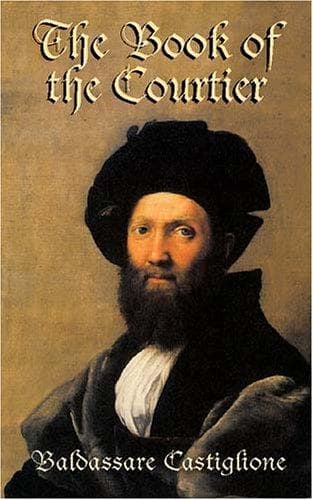
The Book of the CourtierCastiglione, Baldassarre, conte
History
The Book of the Courtier
Castiglione, Baldassarre, conte
Courtesy -- Early works to 1800; Courts and courtiers -- Early works to 1800
26.—“Therefore he who wishes to be a good pupil, besides performing his
tasks well, must put forth every effort to resemble his master, and, if
it were possible, to transform himself into his master. And when he
feels that he has made some progress, it will be very profitable to
observe different men of the same calling, and governing himself with
that good judgment which must ever be his guide, to go about selecting
now this thing from one and that thing from another. And as the bee in
the green meadows is ever wont to rob the flowers among the grass, so
our Courtier must steal this grace from all who seem to possess it,
taking from each that part which shall most be worthy praise; and not
act like a friend of ours whom you all know, who thought he greatly
resembled King Ferdinand the Younger[32] of Aragon, and made it his care
to imitate the latter in nothing but a certain trick of continually
raising the head and twisting one side of the mouth, which the king had
contracted from some infirmity. And there are many such, who think they
gain a point if only they be like a great man in some thing; and
frequently they devote themselves to that which is his only fault.
“But having before now often considered whence this grace springs,
laying aside those men who have it by nature, I find one universal rule
concerning it, which seems to me worth more in this matter than any
other in all things human that are done or said: and that is to avoid
affectation to the uttermost and as it were a very sharp and dangerous
rock; and, to use possibly a new word, to practise in everything a
certain nonchalance[73] that shall conceal design and show that what is
done and said is done without effort and almost without thought. From
this I believe grace is in large measure derived, because everyone knows
the difficulty of those things that are rare and well done, and
therefore facility in them excites the highest admiration; while on the
other hand, to strive and as the saying is to drag by the hair, is
extremely ungraceful, and makes us esteem everything slightly, however
great it be.
“Accordingly we may affirm that to be true art which does not appear to
be art; nor to anything must we give greater care than to conceal art,
for if it is discovered, it quite destroys our credit and brings us into
small esteem. And I remember having once read that there were several
very excellent orators of antiquity, who among their other devices
strove to make everyone believe that they had no knowledge of letters;
and hiding their knowledge they pretended that their orations were
composed very simply and as if springing rather from nature and truth
than from study and art; the which, if it had been detected, would have
made men wary of being duped by it.
Public-domain text, read in full here on John Shaqi.
Reviews
Reviews
No reviews yet
Be the first to share your thoughts on this work.
Join the Discussion
Join the discussion
Sign in to leave a comment or review.
Sign InorCreate an account