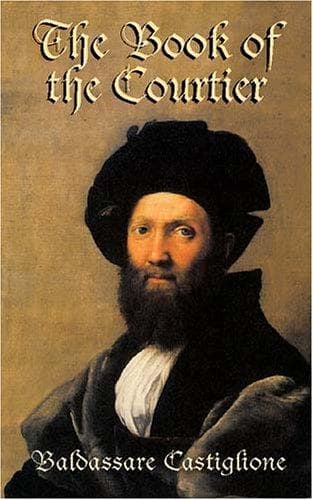
The Book of the CourtierCastiglione, Baldassarre, conte
History
The Book of the Courtier
Castiglione, Baldassarre, conte
Courtesy -- Early works to 1800; Courts and courtiers -- Early works to 1800
“Thus you see how the exhibition of art and study so intense destroys
the grace in everything. Which of you is there who does not laugh when
our friend messer Pierpaolo dances in his peculiar way, with those
capers of his,—legs stiff to the toe and head motionless, as if he were
a stick, and with such intentness that he actually seems to be counting
the steps? What eye so blind as not to see in this the ungracefulness of
affectation,—and in many men and women who are here present, the grace
of that nonchalant ease (for in the case of bodily movements many call
it thus), showing by word or laugh or gesture that they have no care and
are thinking more of everything else than of that, to make the onlooker
think they can hardly go amiss?”
27.—Messer Bernardo Bibbiena here said, without waiting:
“Now at last our friend messer Roberto[48] has found someone to praise
the manner of his dancing, as all the rest of you seem to value it
lightly; because if this merit consists in nonchalance, and in appearing
to take no heed and to be thinking more of everything else than of what
you are doing, messer Roberto in dancing has no peer on earth; for to
show plainly that he is not thinking about it, he often lets the cloak
drop from his shoulders and the slippers from his feet, and still goes
on dancing without picking up either the one or the other.”
Then the Count replied:
“Since you insist on my talking, I will speak further of our faults. Do
you not perceive that what you call nonchalance in messer Roberto, is
really affectation? For it is clearly seen that he is striving with all
his might to seem to be taking no thought, and this is taking too much
thought; and since it passes the true limits of moderation, his
nonchalance is affected and unbecoming; and it is a thing that works
precisely the reverse of the effect intended, that is the concealment of
art. Thus in nonchalance (which is praiseworthy in itself), I do not
think that it is less a vice of affectation to let the clothes fall from
one’s back, than in care of dress (which also is praiseworthy in itself)
to hold the head stiff for fear of disarranging one’s locks, or to carry
a mirrour in the peak of one’s cap and a comb in one’s sleeve, and to
have a valet follow one about the streets with sponge and brush: for
such care in dress and such nonchalance both touch upon excess, which is
always offensive and contrary to that pure and charming simplicity which
is so pleasing to the human mind.
Public-domain text, read in full here on John Shaqi.
Reviews
Reviews
No reviews yet
Be the first to share your thoughts on this work.
Join the Discussion
Join the discussion
Sign in to leave a comment or review.
Sign InorCreate an account