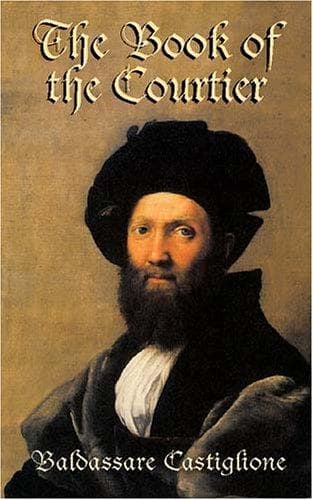
The Book of the CourtierCastiglione, Baldassarre, conte
History
The Book of the Courtier
Castiglione, Baldassarre, conte
Courtesy -- Early works to 1800; Courts and courtiers -- Early works to 1800
“It is the same with many Greek and Latin poets, who, although different
in their writing, are equal in their fame. The orators, too, have always
had so much diversity among themselves, that almost every age has
produced and prized a type of orator peculiar to its own time; and these
have been different not only from their predecessors and successors, but
from one another: as it is written of Isocrates, Lysias, Æschines,[101]
and many others among the Greeks,—all excellent, yet each resembling no
one but himself. So, among the Latins, Carbo, Lælius, Scipio Africanus,
Galba, Sulpicius, Cotta, Gracchus, Marcus Antonius, Crassus,[102] and so
many others that it would be tedious to name them,—all good and very
different one from another; so that if a man were able to consider all
the orators that have been in the world, he would find as many kinds of
oratory as of orators. I think I remember too that Cicero in a certain
place[103] makes Marcus Antonius say to Sulpicius that there are many
who imitate no man and yet arrive at the highest pitch of excellence;
and he speaks of certain ones who had introduced a new form and figure
of speech, beautiful but not usual among the orators of that time,
wherein they imitated no one but themselves. For that reason he affirms
also that masters ought to consider the pupils’ nature, and taking this
as guide ought to direct and aid them to the path towards which their
aptitude and natural disposition incline them. Hence I believe, dear
messer Federico, that if a man has no innate affinity for any particular
author, it is not well to force him to imitate, because the vigour[104]
of his faculty languishes and is impeded when turned from the channel in
which it would have made progress had that channel not been barred.
“Therefore I do not see how it can be well, instead of enriching this
language of ours and giving it spirit and grandeur and light, to make it
poor, thin, humble and obscure, and to try to restrict it in such narrow
bounds that everyone shall be forced to imitate Petrarch and Boccaccio
alone; and how, in respect of language, we ought not also to give
credence to Poliziano,[105] to Lorenzo de’ Medici,[106] to Francesco
Diacceto,[107] and to some others who are also Tuscans and perhaps of no
less learning and judgment than were Petrarch and Boccaccio. And great
pity would it be indeed to set a limit, and not to surpass that which
almost the earliest writers achieved, and to deny that so many men of
such noble genius can ever find more than one beautiful form of
expression in this language which is proper and natural to them. But
to-day there are certain scrupulous souls, who so frighten the listener
with the cult and ineffable mysteries of this Tuscan tongue of theirs,
as to put even many a noble and learned man in such fear, that he dare
not open his mouth and confesses that he does not know how to speak the
very language which he learned in swaddling clothes from his nurse.
Public-domain text, read in full here on John Shaqi.
Reviews
Reviews
No reviews yet
Be the first to share your thoughts on this work.
Elsewhere in the archive
Join the Discussion
Join the discussion
Sign in to leave a comment or review.
Sign InorCreate an account