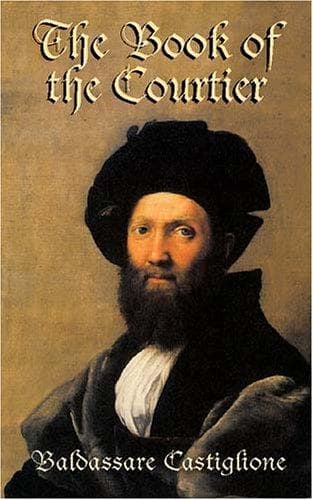
The Book of the CourtierCastiglione, Baldassarre, conte
History
The Book of the Courtier
Castiglione, Baldassarre, conte
Courtesy -- Early works to 1800; Courts and courtiers -- Early works to 1800
“However I think we have said only too much of this; so now let us go on
with our discussion about the Courtier.”
38.—Then messer Federico replied:
“I should first like to say one thing more, which is that I do not deny
men’s opinions and aptitudes to be different among themselves. Nor do I
believe that it would be well for a naturally vehement and excitable man
to set himself to write of placid themes, or for another, being severe
and grave, to write jests; for in this matter it seems to me reasonable
that everyone should adapt himself to his own proper instinct. And I
think Cicero was speaking of this when he said that masters ought to
have regard to their pupils’ nature, in order not to act like bad
husbandmen, who will sometimes sow grain in land that is fruitful only
for the vine.
“Still I cannot get it into my head why, in the case of a particular
language,—which is not proper to all men equally, like speech and
thought and many other functions, but an invention of limited use,—it is
not more rational to imitate those who speak better, than to speak at
random; or why, just as in Latin we ought to try to approach the
language of Virgil and Cicero rather than that of Silius or Cornelius
Tacitus,[108] it is not better in the vernacular also to imitate the
language of Petrarch and Boccaccio than any other’s; yet to express our
thoughts in it well, and thus to give heed to our own natural instinct,
as Cicero teaches. And in this way it will be found that the difference
which you say there is among good orators, consists in sense and not in
language.”
Then the Count said:
“I fear we shall be entering on a wide sea, and shall be leaving our
first subject of the Courtier. However, I ask you in what consists the
excellence of this language?”
Messer Federico replied:
“In preserving strictly its proprieties, in giving it that sense, and in
using that style and those rhythms, which have been used by all who have
written well.”
“I should like to know,” said the Count, “whether this style and these
rhythms of which you speak, arise from the thought or from the words.”
“From the words,” replied messer Federico.
“Then,” said the Count, “do not the words of Silius and Cornelius
Tacitus seem to you the same that Virgil and Cicero use? and employed in
the same sense?”
“Certainly they are the same,” replied messer Federico, “but some of
them wrongly applied and turned awry.”
The Count replied:
“And if from a book of Cornelius and from one of Silius, all those words
were removed that are used in a sense different from that of Virgil and
Cicero, which would be very few,—would you not then say that Cornelius
was the equal of Cicero in language, and Silius of Virgil, and that it
would be well to imitate their manner of speech?”
39.—Then my lady Emilia said:
“Methinks this debate of yours is far too long and tedious; therefore it
were well to postpone it to another time.”
Public-domain text, read in full here on John Shaqi.
Reviews
Reviews
No reviews yet
Be the first to share your thoughts on this work.
Elsewhere in the archive
Join the Discussion
Join the discussion
Sign in to leave a comment or review.
Sign InorCreate an account