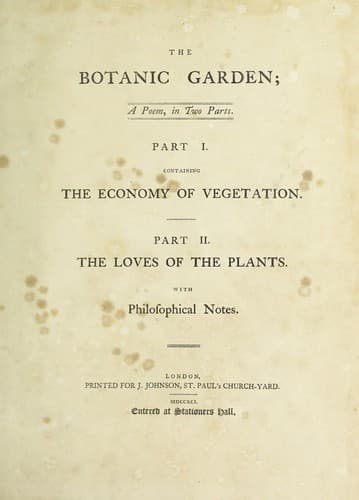
The Botanic Garden. Part 2, Containing the Loves of the Plants. A Poem.: With Philosophical Notes.Darwin, Erasmus
History
The Botanic Garden. Part 2, Containing the Loves of the Plants. A Poem.: With Philosophical Notes.
Darwin, Erasmus
Natural history; Plants -- Poetry
With sighs and sorrows her compassion moves,
And wins the damsel to illicit loves.
The Monster-offspring heirs the father's pride,
Mask'd in the damask beauties of the bride.
305 So, when the Nightingale in eastern bowers
On quivering pinion woos the Queen of flowers;
Inhales her fragrance, as he hangs in air,
And melts with melody the blushing fair;
Half-rose, half-bird, a beauteous Monster springs,
310 Waves his thin leaves, and claps his glossy wings;
Long horrent thorns his mossy legs surround,
And tendril-talons root him to the ground;
Green films of rind his wrinkled neck o'espread,
And crimson petals crest his curled head;
315 Soft-warbling beaks in each bright blossom move,
And vocal Rosebuds thrill the enchanted grove!--
Admiring Evening stays her beamy star,
And still Night listens from his ebon ear;
While on white wings descending Houries throng,
320 And drink the floods of odour and of song.
When from his golden urn the Solstice pours
O'er Afric's sable sons the sultry hours;
When not a gale flits o'er her tawny hills,
Save where the dry Harmattan breathes and kills;
[_The dry Harmattan_. l. 324. The Harmattan is a singular wind blowing
from the interior parts of Africa to the Atlantic ocean, sometimes for
a few hours, sometimes for several days without regular periods. It is
always attended with a fog or haze, so dense as to render those objects
invisible which are at the distance of a quarter of a mile; the sun
appears through it only about noon, and then of a dilute red, and very
minute particles subside from the misty air so as to make the grass, and
the skins of negroes appear whitish. The extreme dryness which attends
this wind or fog, without dews, withers and quite dries the leaves of
vegetables; and is said of Dr. Lind at some seasons to be fatal and
malignant to mankind; probably after much preceding wet, when it may
become loaded with the exhalations from putrid marshes; at other
seasons it is said to check epidemic diseases, to cure fluxes, and
to heal ulcers and cutaneous eruptions; which is probably effected by its
yielding no moisture to the mouths of the external absorbent vessels,
by which the action of the other branches of the absorbent system is
increased to supply the deficiency. _Account of the Harmattan. Phil.
Transact. V. LXXI._
The Rev. Mr. Sterling gives an account of a darkness for six or eight
hours at Detroit in America, on the 19th of October, 1762, in which
the sun appeared as red as blood, and thrice its usual size: some rain
falling, covered white paper with dark drops, like sulphur or dirt, which
burnt like wet gunpowder, and the air had a very sulphureous smell.
He supposes this to have been emitted from some distant earthquake or
volcano. Philos. Trans. V. LIII. p. 63.
Public-domain text, read in full here on John Shaqi.
Reviews
Reviews
No reviews yet
Be the first to share your thoughts on this work.
Elsewhere in the archive
Join the Discussion
Join the discussion
Sign in to leave a comment or review.
Sign InorCreate an account