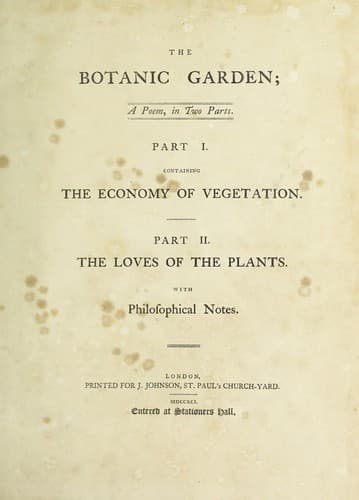
The Botanic Garden. Part 2, Containing the Loves of the Plants. A Poem.: With Philosophical Notes.Darwin, Erasmus
History
The Botanic Garden. Part 2, Containing the Loves of the Plants. A Poem.: With Philosophical Notes.
Darwin, Erasmus
Natural history; Plants -- Poetry
I have said before, that malefactors are instructed to go to the tree
with the wind, and to return against the wind. When the wind continues to
blow from the same quarter while the delinquent travels thirty, or six
and thirty miles, if he be of a good constitution, he certainly survives.
But what proves the most destructive is, that there is no dependence on
the wind in that part of the world for any length of time.--There are no
regular land-winds; and the sea-wind is not perceived there at all, the
situation of the tree being at too great a distance, and surrounded by
high mountains and uncultivated forests. Besides, the wind there never
blows a fresh regular gale, but is commonly merely a current of light,
soft breezes, which pass through the different openings of the adjoining
mountains. It is also frequently difficult to determine from what part of
the globe the wind really comes, as it is divided by various obstructions
in its passage, which easily change the direction of the wind, and often
totally destroy its effects.
I, therefore, impute the distant effects of the poison, in a great
measure, to the constant gentle winds in those parts, which have not
power enough to disperse the poisonous particles. If high winds are more
frequent and durable there, they would certainly weaken very much, and
even destroy the obnoxious effluvia of the poison; but without them, the
air remains infested and pregnant with these poisonous vapours.
I am the more convinced of this, as the worthy ecclesiastick assured me,
that a dead calm is always attended with the greatest danger, as there is
a continual perspiration issuing from the tree, which is seen to rise and
spread in the air, like the putrid steam of a marshy cavern.
_Experiments made with the Gum of the UPAS TREE._
In the year 1776, in the month of February, I was present at the
execution of thirteen of the Emperor's concubines, at _Soura-Charta,_
who were convicted of infidelity to the Emperor's bed. It was in the
forenoon, about eleven o'clock, when the fair criminals were led into
an open space within the walls of the Emperor's palace. There the judge
passed sentence upon them, by which they are doomed to suffer death by a
lancet poisoned with Upas. After this the Alcoran was presented to them,
and they were, according to the law of their great prophet Mahomet, to
acknowledge and to affirm by oath, that the charges brought against them,
together with the sentence and their punishment, were fair and equitable.
This they did, by laying their right hand upon the Alcoran, their left
hands upon their breast, and their eyes lifted towards heaven; the judge
then held the Alcoran to their lips, and they kissed it.
Public-domain text, read in full here on John Shaqi.
Reviews
Reviews
No reviews yet
Be the first to share your thoughts on this work.
Elsewhere in the archive
Join the Discussion
Join the discussion
Sign in to leave a comment or review.
Sign InorCreate an account