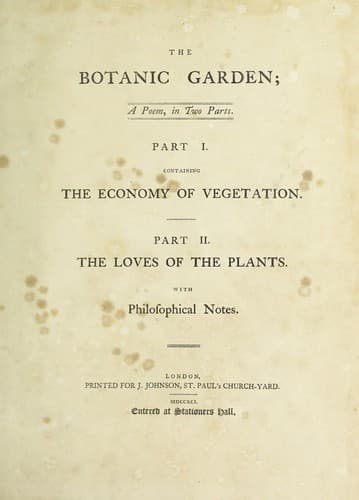
The Botanic Garden. Part 2, Containing the Loves of the Plants. A Poem.: With Philosophical Notes.Darwin, Erasmus
History
The Botanic Garden. Part 2, Containing the Loves of the Plants. A Poem.: With Philosophical Notes.
Darwin, Erasmus
Natural history; Plants -- Poetry
I thought it necessary to try also the effect of the poison given
inwardly, which I did in the following manner. I dissolved a quarter of
a grain of the gum in half an ounce of arrack, and made a dog of seven
months old drink it. In seven minutes a retching ensued, and I observed,
at the same time, that the animal was delirious, as it ran up and down
the room, fell on the ground, and tumbled about; then it rose again,
cried out very loud, and in about half an hour after was seized with
convulsions, and died. I opened the body, and found the stomach very much
inflamed, as the intestines were in some parts, but not so much as the
stomach. There was a small quantity of coagulated blood in the stomach;
but I could discover no orifice from which it could have issued; and
therefore supposed it to have been squeezed out of the lungs, by the
animal's straining while it was vomiting.
From these experiments I have been convinced that the gum of the Upas is
the most dangerous and most violent of all vegetable poisons; and I am
apt to believe that it greatly contributes to the unhealthiness of that
island. Nor is this the only evil attending it: hundreds of the natives
of Java, as well as Europeans, are yearly destroyed and treacherously
murdered by that poison, either internally or externally. Every man of
quality or fashion has his dagger or other arms poisoned with it; and in
times of war the Malayans poison the springs and other waters with it; by
this treacherous practice the Dutch suffered greatly during the last war,
as it occasioned the loss of half their army. For this reason, they have
ever since kept fish in the springs of which they drink the water; and
sentinels are placed near them, who inspect the waters every hour, to see
whether the fish are alive. If they march with an army or body of troops
into an enemy's country, they always carry live fish with them, which
they throw into the water some hours before they venture to drink it; by
which means they have been able to prevent their total destruction.
This account, I flatter myself, will satisfy the curiosity of my readers,
and the few facts which I have related will be considered as a certain
proof of the exigence of this pernicious tree, and its penetrating
effects.
If it be asked why we have not yet any more satisfactory accounts of this
tree, I can only answer, that the object to most travellers to that part
of the world consists more in commercial pursuits than in the study of
Natural History and the advancement of Sciences. Besides, Java is so
universally reputed an unhealthy island, that rich travellers seldom
make any long stay in it; and others want money, and generally are too
ignorant of the language to travel, in order to make enquiries. In
future, those who visit this island will probably now be induced to make
it an object of their researches, and will furnish us with a fuller
description of this tree.
Public-domain text, read in full here on John Shaqi.
Reviews
Reviews
No reviews yet
Be the first to share your thoughts on this work.
Elsewhere in the archive
Join the Discussion
Join the discussion
Sign in to leave a comment or review.
Sign InorCreate an account