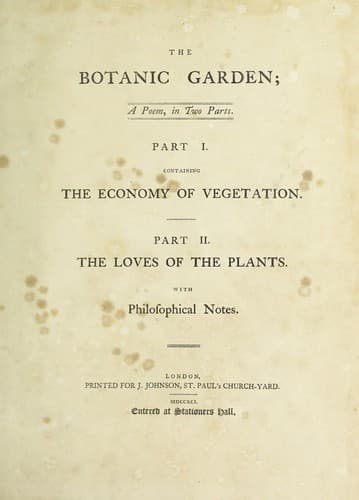
The Botanic Garden. Part 2, Containing the Loves of the Plants. A Poem.: With Philosophical Notes.Darwin, Erasmus
History
The Botanic Garden. Part 2, Containing the Loves of the Plants. A Poem.: With Philosophical Notes.
Darwin, Erasmus
Natural history; Plants -- Poetry
Here paused the Goddess,--on HYGEIA'S shrine
Obsequious Gnomes repose the lyre divine;
475 Descending Sylphs relax the trembling strings,
And catch the rain-drops on their shadowy wings.
--And now her vase a modest Naiad fills
With liquid crystal from her pebbly rills;
Piles the dry cedar round her silver urn,
480 (Bright climbs the blaze, the crackling faggots burn),
Culls the green herb of China's envy'd bowers,
In gaudy cups the steamy treasure pours;
And, sweetly-smiling, on her bended knee
Presents the fragrant quintessence of Tea.
INTERLUDE II.
_Bookseller._ The monsters of your Botanic Garden are as surprising as
the bulls with brazen feet, and the fire-breathing dragons, which guarded
the Hesperian fruit; yet are they not disgusting, nor mischievous: and
in the manner you have chained them together in your exhibition, they
succeed each other amusingly enough, like prints of the London Cries,
wrapped upon rollers, with a glass before them. In this at least they
resemble the monsters in Ovid's Metamorphoses; but your similies, I
suppose, are Homeric?
_Poet._ The great Bard well understood how to make use of this kind of
ornament in Epic Poetry. He brings his valiant heroes into the field with
much parade, and sets them a fighting with great fury; and then, after a
few thrusts and parries, he introduces a long string of similies. During
this the battle is supposed to continue; and thus the time necessary for
the action is gained in our imaginations; and a degree of probability
produced, which contributes to the temporary deception or reverie of the
reader.
But the similies of Homer have another agreeable characteristic; they
do not quadrate, or go upon all fours (as it is called), like the more
formal similies of some modern writers; any one resembling feature seems
to be with him a sufficient excuse for the introduction of this kind of
digression; he then proceeds to deliver some agreeable poetry on this new
subject, and thus converts every simile into a kind of short episode.
_B._ Then a simile should not very accurately resemble the subject?
_P._ No; it would then become a philosophical analogy, it would be
ratiocination instead of poetry: it need only so far resemble the
subject, as poetry itself ought to resemble nature. It should have so
much sublimity, beauty, or novelty, as to interest the reader; and should
be expressed in picturesque language, so as to bring the scenery before
his eye; and should lastly bear so much veri-similitude as not to awaken
him by the violence of improbability or incongruity.
Public-domain text, read in full here on John Shaqi.
Reviews
Reviews
No reviews yet
Be the first to share your thoughts on this work.
Elsewhere in the archive
Join the Discussion
Join the discussion
Sign in to leave a comment or review.
Sign InorCreate an account