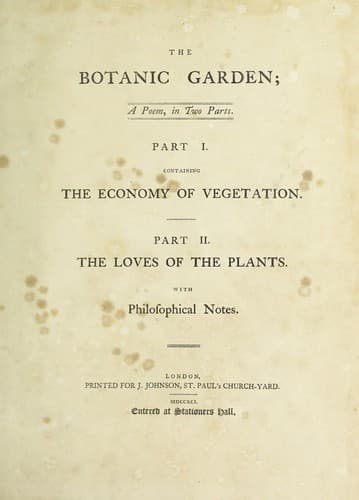
The Botanic Garden. Part 2, Containing the Loves of the Plants. A Poem.: With Philosophical Notes.Darwin, Erasmus
History
The Botanic Garden. Part 2, Containing the Loves of the Plants. A Poem.: With Philosophical Notes.
Darwin, Erasmus
Natural history; Plants -- Poetry
_B._ May not the reverie of the reader be dissipated or disturbed by
disagreeable images being presented to his imagination, as well as by
improbable or incongruous ones? _P_. Certainly; he will endeavour to
rouse himself from a disagreeable reverie, as from the night-mare. And
from this may be discovered the line of boundary between the Tragic and
the Horrid: which line, however, will veer a little this way or that,
according to the prevailing manners of the age or country, and the
peculiar associations of ideas, or idiosyncracy of mind, of individuals.
For instance, if an artist should represent the death of an officer in
battle, by shewing a little blood on the bosom of his shirt, as if a
bullet had there penetrated, the dying figure would affect the beholder
with pity; and if fortitude was at the same time expressed in his
countenance, admiration would be added to our pity. On the contrary, if
the artist should chuse to represent his thigh as shot away by a cannon
ball, and should exhibit the bleeding flesh and shattered bone of the
stump, the picture would introduce into our minds ideas from a butcher's
shop, or a surgeon's operation-room, and we should turn from it with
disgust. So if characters were brought upon the stage with their limbs
disjointed by torturing instruments, and the floor covered with clotted
blood and scattered brains, our theatric reverie would be destroyed by
disgust, and we should leave the play-house with detestation.
The Painters have been more guilty in this respect than the Poets; the
cruelty of Apollo in flaying Marcias alive is a favourite subject with
the antient artists: and the tortures of expiring martyrs have disgraced
the modern ones. It requires little genius to exhibit the muscles in
convulsive action either by the pencil or the chissel, because the
interstices are deep, and the lines strongly defined: but those tender
gradations of muscular action, which constitute the graceful attitudes of
the body, are difficult to conceive or to execute, except by a master of
nice discernment and cultivated taste. _B._ By what definition would you
distinguish the Horrid from the Tragic?
_P._ I suppose the latter consists of Distress attended with Pity, which
is said to be allied to Love, the most agreeable of all our passions;
and the former in Distress, accompanied with Disgust, which is allied to
Hate, and is one of our most disagreeable sensations. Hence, when horrid
scenes of cruelty are represented in pictures, we wish to disbelieve
their existence, and voluntarily exert ourselves to escape from the
deception: whereas the bitter cup of true Tragedy is mingled with some
sweet consolatory drops, which endear our tears, and we continue to
contemplate the interesting delusion with a delight which it is not easy
to explain.
Public-domain text, read in full here on John Shaqi.
Reviews
Reviews
No reviews yet
Be the first to share your thoughts on this work.
Elsewhere in the archive
Join the Discussion
Join the discussion
Sign in to leave a comment or review.
Sign InorCreate an account