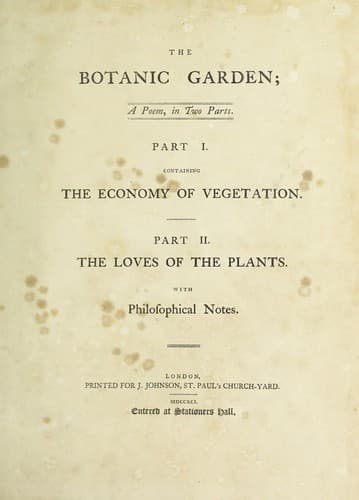
The Botanic Garden. Part 2, Containing the Loves of the Plants. A Poem.: With Philosophical Notes.Darwin, Erasmus
History
The Botanic Garden. Part 2, Containing the Loves of the Plants. A Poem.: With Philosophical Notes.
Darwin, Erasmus
Natural history; Plants -- Poetry
Where seas of glass with gay reflections smile
220 Round the green coasts of Java's palmy isle;
A spacious plain extends its upland scene,
Rocks rise on rocks, and fountains gush between;
Soft zephyrs blow, eternal summers reign,
And showers prolific bless the soil,--in vain!
225 --No spicy nutmeg scents the vernal gales,
Nor towering plaintain shades the mid-day vales;
No grassy mantle hides the sable hills,
No flowery chaplet crowns the trickling rills;
Nor tufted moss, nor leathery lichen creeps
230 In russet tapestry o'er the crumbling steeps.
--No step retreating, on the sand impress'd,
Invites the visit of a second guest;
No refluent fin the unpeopled stream divides,
No revolant pinion cleaves the airy tides;
235 Nor handed moles, nor beaked worms return,
That mining pass the irremeable bourn.--
Fierce in dread silence on the blasted heath
Fell UPAS sits, the HYDRA-TREE of death.
Lo! from one root, the envenom'd soil below,
240 A thousand vegetative serpents grow;
In shining rays the scaly monster spreads
O'er ten square leagues his far-diverging heads;
Or in one trunk entwists his tangled form,
Looks o'er the clouds, and hisses in the storm.
[_Upas_. l. 238. There is a poison-tree in the island of Java, which is
said by its effluvia to have depopulated the country for 12 or 14 miles
round the place of its growth. It is called, in the Malayan language,
Bohon-Upas; with the juice of it the most poisonous arrows are prepared;
and, to gain this, the condemned criminals are sent to the tree with
proper direction both to get the juice and to secure themselves from the
malignant exhalations of the tree; and are pardoned if they bring back a
certain quantity of the poison. But by the registers there kept, not
one in four are said to return. Not only animals of all kinds, both
quadrupeds, fish, and birds, but all kinds of vegetables also are
destroyed by the effluvia of the noxious tree; so that, in a district of
12 or 14 miles round it, the face of the earth is quite barren and rocky,
intermixed only with the skeletons of men and animals; affording a scene
of melancholy beyond what poets have described or painters delineated.
Two younger trees of its own species are said to grow near it. See
London Magazine for 1784, or 1783. Translated from a description of the
poison-tree of the island of Java, written in Dutch by N.P. Foereh. For
a further account of it, see a note at the end of the work.]
Public-domain text, read in full here on John Shaqi.
Reviews
Reviews
No reviews yet
Be the first to share your thoughts on this work.
Elsewhere in the archive
Join the Discussion
Join the discussion
Sign in to leave a comment or review.
Sign InorCreate an account