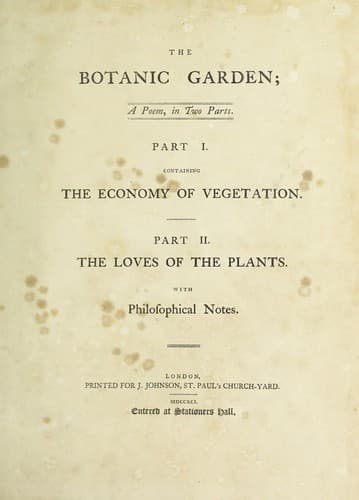
The Botanic Garden. Part 2, Containing the Loves of the Plants. A Poem.: With Philosophical Notes.Darwin, Erasmus
History
The Botanic Garden. Part 2, Containing the Loves of the Plants. A Poem.: With Philosophical Notes.
Darwin, Erasmus
Natural history; Plants -- Poetry
[_Rolls his brineless tide._ l. 411. Some philosophers have believed
that the continent of America was not raised out of the great ocean at
so early a period of time as the other continents. One reason for this
opinion was, because the great lakes, perhaps nearly as large as the
Mediterranean Sea, consist of fresh water. And as the sea-salt seems to
have its origin from the destruction of vegetable and animal bodies,
washed down by rains, and carried by rivers into lakes or seas; it
would seem that this source of sea-salt had not so long existed in that
country. There is, however, a more satisfactory way of explaining this
circumstance; which is, that the American lakes lie above the level of
the ocean, and are hence perpetually desalited by the rivers which run
through them; which is not the case with the Mediterranean, into which a
current from the main ocean perpetually passes.]
[_Caffia._ l. 413. Ten males, one female. The seeds are black, the
stamens gold-colour. This is one of the American fruits, which are
annually thrown on the coasts of Norway; and are frequently in so recent
a state as to vegetate, when properly taken care of, the fruit of the
anacardium, cashew-nut; of cucurbita lagenaria, bottlegourd; of the
mimosa scandens, cocoons; of the piscidia erythrina, logwood-tree; and
cocoa-nuts are enumerated by Dr. Tonning. (Amæn. Acad. 149.) amongst
these emigrant seeds. The fact is truly wonderful, and cannot be
accounted for but by the existence of under currents in the depths of the
ocean; or from vortexes of water passing from one country to another
through caverns of the earth.
Sir Hans Sloane has given an account of four kinds of seeds, which are
frequently thrown by the sea upon the coasts of the islands of the
northern parts of Scotland. Phil. Trans. abridged, Vol. III. p. 540.
which seeds are natives of the West Indies, and seem to be brought
thither by the gulf-stream described below. One of these is called, by
Sir H. Sloane, Phaseolus maximus perennis, which is often also thrown
on the coast of Kerry in Ireland; another is called, in Jamaica,
Horse-eye-bean; and a third is called Niker in Jamaica. He adds, that
the Lenticula marina, or Sargosso, grows on the rocks about Jamaica, is
carried by the winds and current towards the coast of Florida, and thence
into the North-American ocean, where it lies very thick on the surface of
the sea.
Public-domain text, read in full here on John Shaqi.
Reviews
Reviews
No reviews yet
Be the first to share your thoughts on this work.
Elsewhere in the archive
Join the Discussion
Join the discussion
Sign in to leave a comment or review.
Sign InorCreate an account