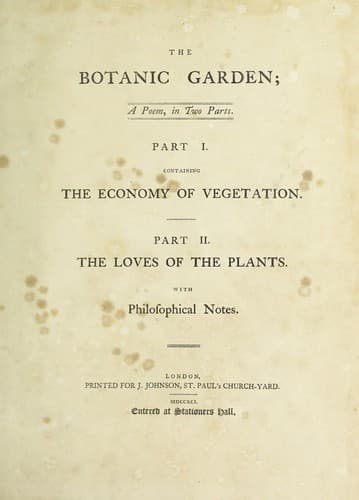
The Botanic Garden. Part 2, Containing the Loves of the Plants. A Poem.: With Philosophical Notes.Darwin, Erasmus
History
The Botanic Garden. Part 2, Containing the Loves of the Plants. A Poem.: With Philosophical Notes.
Darwin, Erasmus
Natural history; Plants -- Poetry
Newton's Optics, Book I. part 2. prop. 3 and 6. Dr. Smith, in his
Harmonics, has an explanatory note upon this happy discovery, as he terms
it, of Newton. Sect. 4. Art. 7. From this curious coincidence, it has
been proposed to produce a luminous music, confiding of successions
or combinations of colours, analogous to a tune in respect to the
proportions above mentioned. This might be performed by a strong light,
made by means of Mr. Argand's lamps, passing through coloured glasses,
and falling on a defined part of a wall, with moveable blinds before
them, which might communicate with the keys of a harpsichord; and thus
produce at the same time visible and audible music in unison with each
other. The execution of this idea is said by Mr. Guyot to have been
attempted by Father Cassel without much success. If this should be
again attempted, there is another curious coincidence between sounds and
colours, discovered by Dr. Darwin of Shrewsbury, and explained in a paper
on what he calls Ocular Spectra, in the Philosophical Transactions, Vol.
LXXVI. which might much facilitate the execution of it. In this treatise
the Doctor has demonstrated, that we see certain colours, not only with
greater ease and distinctness, but with relief and pleasure, after having
for some time contemplated other certain colours; as green after red, or
red after green; orange after blue, or blue after orange; yellow after
violet, or violet after yellow. This he shews arises from the _ocular
spectrum_ of the colour last viewed coinciding with the _irritation_ of
the colour now under contemplation. Now as the pleasure we receive
from the sensation of melodious notes, independent of the previous
associations of agreeable ideas with them, must arise from our hearing
some proportions of sounds after others more easily, distinctly, or
agreeably; and as there is a coincidence between the proportions of the
primary colours, and the primary sounds, if they may be so called; he
argues, that the same laws must govern the sensations of both. In this
circumstance, therefore, consists the sisterhood of Music and Painting;
and hence they claim a right to borrow metaphors from each other;
musicians to speak of the brilliancy of sounds, and the light and shade
of a concerto; and painters of the harmony of colours, and the tone of a
picture. Thus it was not quite so absurd, as was imagined, when the blind
man asked if the colour scarlet was like the sound of a trumpet. As the
coincidence or opposition of these _ocular spectra_, (or colours which
remain in the eye after having for some time contemplated a luminous
object) are more easily and more accurately ascertained, now their laws
have been investigated by Dr. Darwin, than the _relicts_ of evanescent
sounds upon the ear; it is to be wished that some ingenious musician
would further cultivate this curious field of science: for if visible
music can be agreeably produced, it would be more easy to add sentiment
Public-domain text, read in full here on John Shaqi.
Reviews
Reviews
No reviews yet
Be the first to share your thoughts on this work.
Elsewhere in the archive
Join the Discussion
Join the discussion
Sign in to leave a comment or review.
Sign InorCreate an account