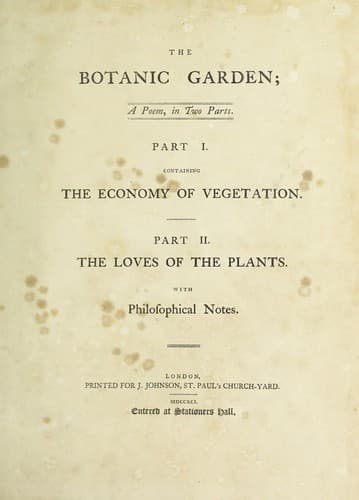
The Botanic Garden. Part 2, Containing the Loves of the Plants. A Poem.: With Philosophical Notes.Darwin, Erasmus
History
The Botanic Garden. Part 2, Containing the Loves of the Plants. A Poem.: With Philosophical Notes.
Darwin, Erasmus
Natural history; Plants -- Poetry
_Cerea._ l. 15. Cactus grandiflorus, or Cereus. Twenty males, one female.
This flower is a native of Jamaica and Veracrux. It expands a most
exquisitely beautiful corol, and emits a most fragrant odour for a few
hours in the night, and then closes to open no more. The flower is nearly
a foot in diameter; the inside of the calyx of a splendid yellow, and the
numerous petals of a pure white: it begins to open about seven or eight
o'clock in the evening, and closes before sun-rise in the morning.
Martyn's Letters, p. 294. The Cistus labdiniferus, and many other
flowers, lose their petals after having been a few hours expanded in
the day-time; for in these plants the stigma is soon impregnated by the
numerous anthers: in many flowers of the Cistus lubdiniferus I observed
two or three of the stamens were perpetually bent into contact with the
pistil.
The Nyctanthes, called Arabian Jasmine, is another flower, which expands
a beautiful corol, and gives out a most delicate perfume during the
night, and not in the day, in its native country, whence its name;
botanical philosophers have not yet explained this wonderful property;
perhaps the plant sleeps during the day as some animals do; and its
odoriferous glands only emit their fragrance during the expansion of
the petals; that is, during its waking hours: the Geranium triste has
the same property of giving up its fragrance only in the night. The
flowers of the Cucurbita lagenaria are said to close when the sun
shines upon them. In our climate many flowers, as tragopogon, and
hibiscus, close their flowers before the hottest part of the day comes
on; and the flowers of some species of cucubalus, and Silene, viscous
campion, are closed all day; but when the sun leaves them they expand,
and emit a very agreeable scent; whence such plants are termed
noctiflora.]
Public-domain text, read in full here on John Shaqi.
Reviews
Reviews
No reviews yet
Be the first to share your thoughts on this work.
Elsewhere in the archive
Join the Discussion
Join the discussion
Sign in to leave a comment or review.
Sign InorCreate an account